


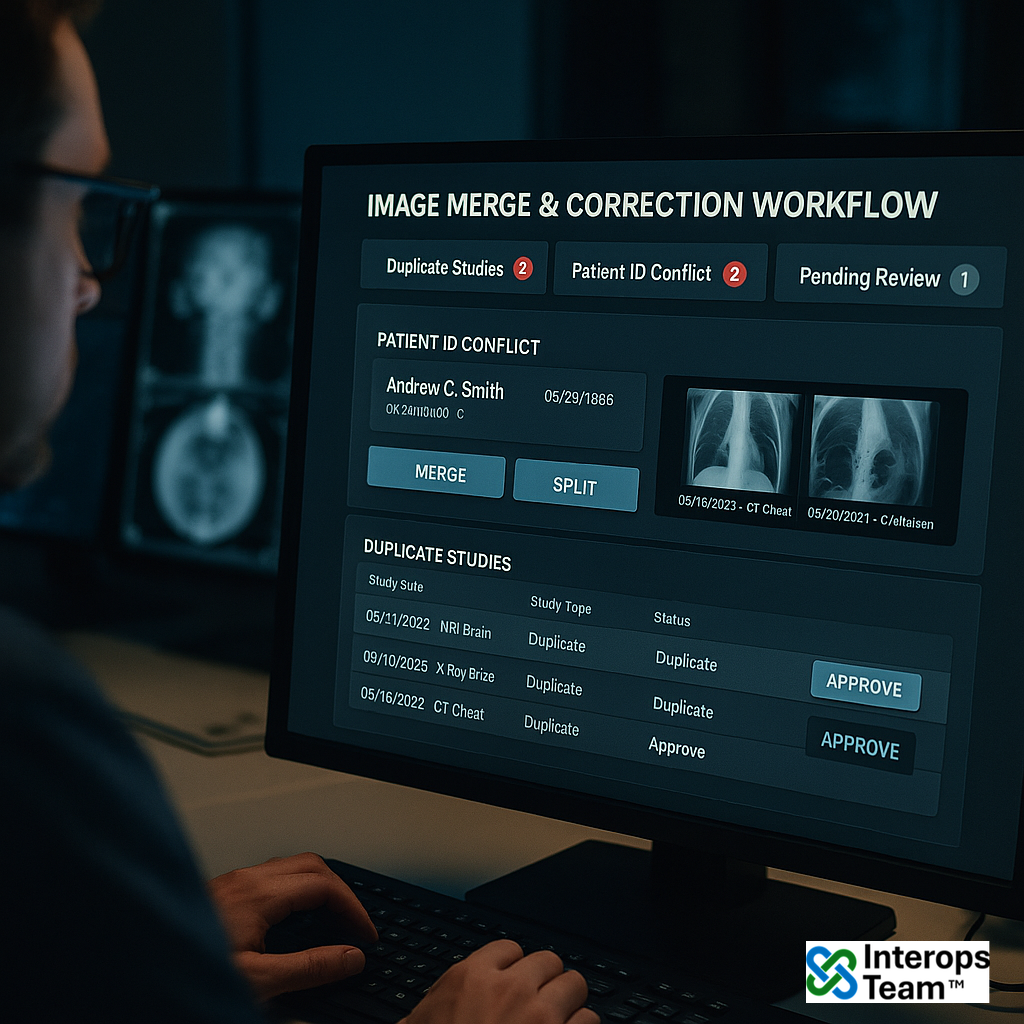
The Imaging Identity Correction Assistant enables EMR-side visibility into mismatched patient or study links detected in imaging workflows.
It uses HL7v2 triggers and EMPI-based matching logic to identify potential errors in patient-to-study associations and initiate correction requests aligned with IHE IOCM (Image Object Change Management) standards.
This solution provides audit-friendly correction prompts, ensuring that discrepancies are captured, reviewed, and routed appropriately, without performing direct PACS/VNA propagation or DICOM-level orchestration. It bridges the EMR and imaging ecosystem by ensuring identity integrity while maintaining a defensible audit trail for compliance and quality governance.
Benefits
- Cleaner longitudinal imaging records: Maintains accurate patient-to-study linkage across EMR and imaging systems.
- Reduced downstream mismatches: Prevents cascading identity errors that impact diagnostic and reporting workflows.
- Defensible reconciliation: Ensures every correction event has traceable provenance and compliance documentation.
- Improved cross-system coordination: Supports safe, EMR-originated correction workflows without overstepping PACS/VNA control boundaries.
Capabilities
- HL7v2 correction triggers: Detect mismatched or reassigned imaging records through ADT/ORM/ORU events.
- EMPI-assisted reconciliation: Match, verify, or suggest the correct patient identity based on enterprise person index data.
- EMR-side mismatch flagging: Surface suspect studies in worklists for HIM or clinical review before IOCM actions are issued downstream.
- Audit and provenance metadata: Capture who identified, verified, and approved each correction with timestamps and policy context.
Great for
- Clinical Informatics and EMR Analysts: Detect and flag mismatched imaging identities early using HL7v2 and EMPI signals without needing PACS/VNA access.
- HIM and Identity Governance Teams: Review, validate, and reconcile patient/study mismatches with structured audit trails aligned to IOCM policy.
- Compliance and Risk Officers: Maintain defensible, policy-aligned correction workflows that demonstrate data integrity and adherence to imaging identity standards.
- Interoperability Architects: Integrate EMR-side detection with downstream IOCM notifications to maintain synchronized identity across systems.
Interops Team enables EMR-side imaging identity governance, bridging HL7v2 and EMPI logic to detect mismatches early, initiate compliant corrections, and preserve audit-ready provenance across the imaging lifecycle.