


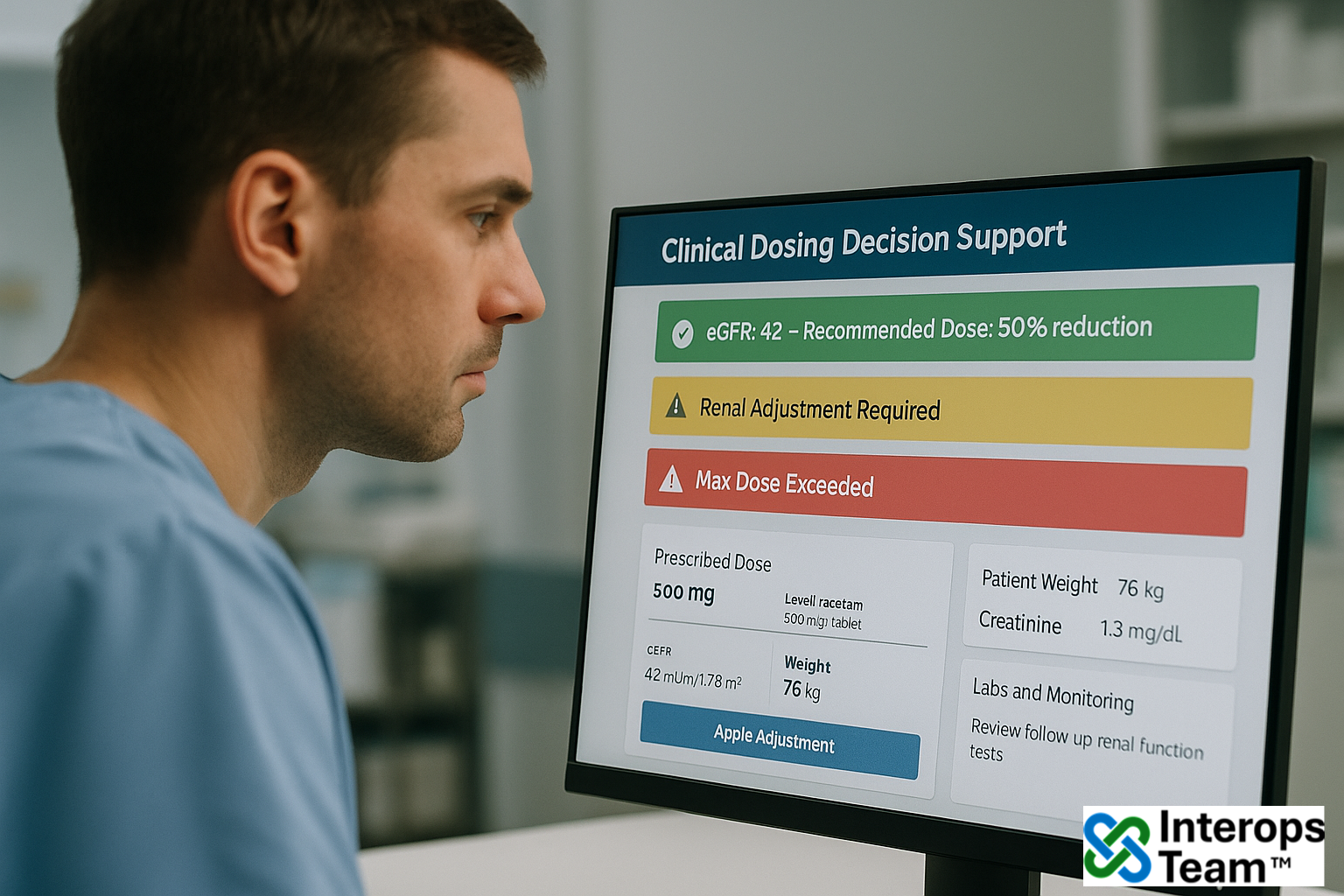
The Clinical Dosing Decision Support module provides real-time, patient-specific dosing guidance at the point of order entry and verification. It evaluates renal and hepatic function (e.g., eGFR, LFTs), age, weight, indication, and cumulative dose history to recommend safe adjustments, enforce maximum dosing limits, and surface required monitoring actions.
Using CDS Hooks triggers during CPOE and pharmacy verification, the app invokes SMART on FHIR calculators to display recommended dose ranges, monitoring requirements, and follow-up lab intervals, all derived from current EMR and lab data.
This ensures dosing remains defensible, policy-aligned, and individualized across complex patient populations.
Benefits
- Safer, individualized therapy: Dynamically adjusts dose based on renal/hepatic function and other patient factors.
- Reduced adverse drug events: Flags out-of-range dosing or missed follow-up labs before administration.
- Consistent policy adherence: Embeds organizational dose limits and adjustment rules directly into ordering workflows.
- Improved pharmacist efficiency: Automates routine dosing checks and standardizes verification across care settings.
Capabilities
- CDS Hooks integration: Triggers dose validation and monitoring prompts during order entry and pharmacy verification.
- SMART on FHIR calculators: Display renal and hepatic adjustment logic with embedded dose equations and patient data context.
- Policy-driven thresholds: Enforces local dosing maximums and contraindication parameters for high-risk medications.
- Follow-up lab reminders: Generates automated tasks for repeat labs (e.g., creatinine, LFTs) based on medication risk class.
- Audit-ready traceability: Logs dosing rationale and overrides for compliance and quality review.
Great for
- Clinical Informatics and EMR Analysts: Implement renal/hepatic dose adjustment and monitoring logic using CDS Hooks and SMART on FHIR for real-time, rule-based validation.
- Pharmacy and Care Team Leads: Ensure individualized, policy-aligned dosing and reinforce monitoring requirements with structured follow-up prompts.
- Quality and Patient Safety Officers: Reduce ADEs and strengthen audit defensibility through standardized dosing checks and lab-linked safeguards.
- Medication Management Committees: Govern dosing thresholds, adjustment equations, and monitoring cadence across therapeutic classes.
Interops Team delivers clinical dosing decision support rooted in SMART on FHIR and CDS Hooks, enabling safe, individualized, and policy-aligned medication management directly within the EMR.