


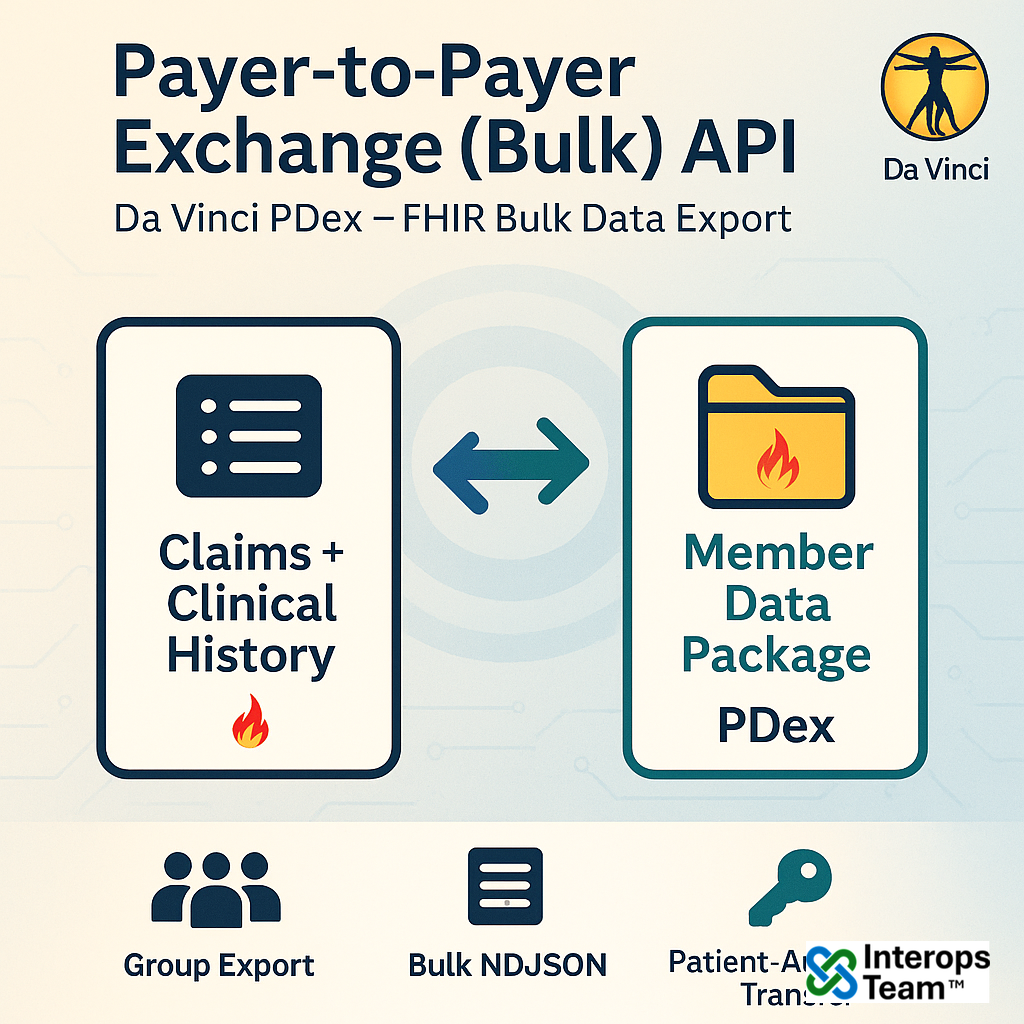
When patients change health plans, their clinical history, claims, and medication data often do not move with them. This results in incomplete records, redundant tests, unsafe medication decisions, and delays in care. The Payer-to-Payer API enables plans to exchange member data securely and in a standardized way—either on a patient-authorized basis (9115-F) or in bulk for new members during enrollment (0057-F). This helps the receiving payer build a more complete member profile from day one.
Member Experience
- Continuity of care when changing insurance plans.
- Faster onboarding with fewer forms and fewer unknowns.
- Reduced need to repeat histories, medication lists, and past diagnoses.
- Smoother transitions with primary care, specialists, and care management programs.
Clinical & Care Management Experience
- Earlier awareness of chronic conditions and historical utilization.
- Improved medication reconciliation and adherence outreach.
- Better risk modeling and identification of members who need immediate support.
- Reduced duplication of workup, imaging, and testing.
Technical & Standards Alignment
- FHIR R4 – PDex Profiles:
Patient,Coverage,ExplanationOfBenefit,Encounter,Claim,Condition,MedicationDispense, and others relevant to member history. - Two modes:
- Member-authorized exchange (9115-F): Third-party app initiates the transfer.
- Bulk transfer (0057-F): Payer-to-Payer exchange at enrollment for new members.
- Use of Bulk FHIR (NDJSON) for high-volume member transitions.
- OAuth 2.0 authorization for member-initiated flows.
- Consent documentation, provenance, and last-updated metadata required.
Governance & Compliance
- Fulfills data portability expectations under 9115-F and 0057-F.
- Clear audit trails of what data was requested, released, and received.
- Defined dispute and correction processes for incomplete transfers.
- Data minimization and secure transport using FHIR RESTful interactions.
- Compliance with data retention, privacy notices, and consent revocation.
Value by Audience
Members:
- Continuity of clinical and claims information across coverage transitions.
- Fewer disruptions in medication, equipment, and chronic care programs.
Payers (Receiving):
- Faster onboarding and earlier risk stratification.
- Better insights to avoid redundant tests or delayed care.
- Improved support for care management, case management, and pharmacy programs.
Payers (Sending):
- Regulatory compliance with minimal manual effort.
- Standardized format reduces ad hoc requests for medical records.
- Less administrative friction during enrollment periods.
IT & Architecture:
- Standards-based exchange instead of custom feeds or manual processes.
- Bulk transfer model scales for large enrollment populations.
- Clear profile definitions and repeatable operations.
Capabilities
- Patient-authorized record transfer between payer systems.
- Bulk Payer Data Exchange for new members joining a plan.
- Support for PDex clinical and claims resources.
- Provenance, timestamps, and last-exported metadata.
- Error reporting and reconciliation for failed or partial transfers.
Da Vinci Alignment
For profiles, patterns, and operational guidance, see the Da Vinci Payer Data Exchange (PDex)Implementation Guide, including the Payer-to-Payer Exchange section for both member-authorized and bulk transfer workflows.
Optional Alternative Approaches
Organizations may supplement Payer-to-Payer APIs with member-facing portability tools or payer-hosted SMART apps that allow patients to directly retrieve or manage their own history. These approaches improve transparency and self-service while relying on the same PDex data foundation.