


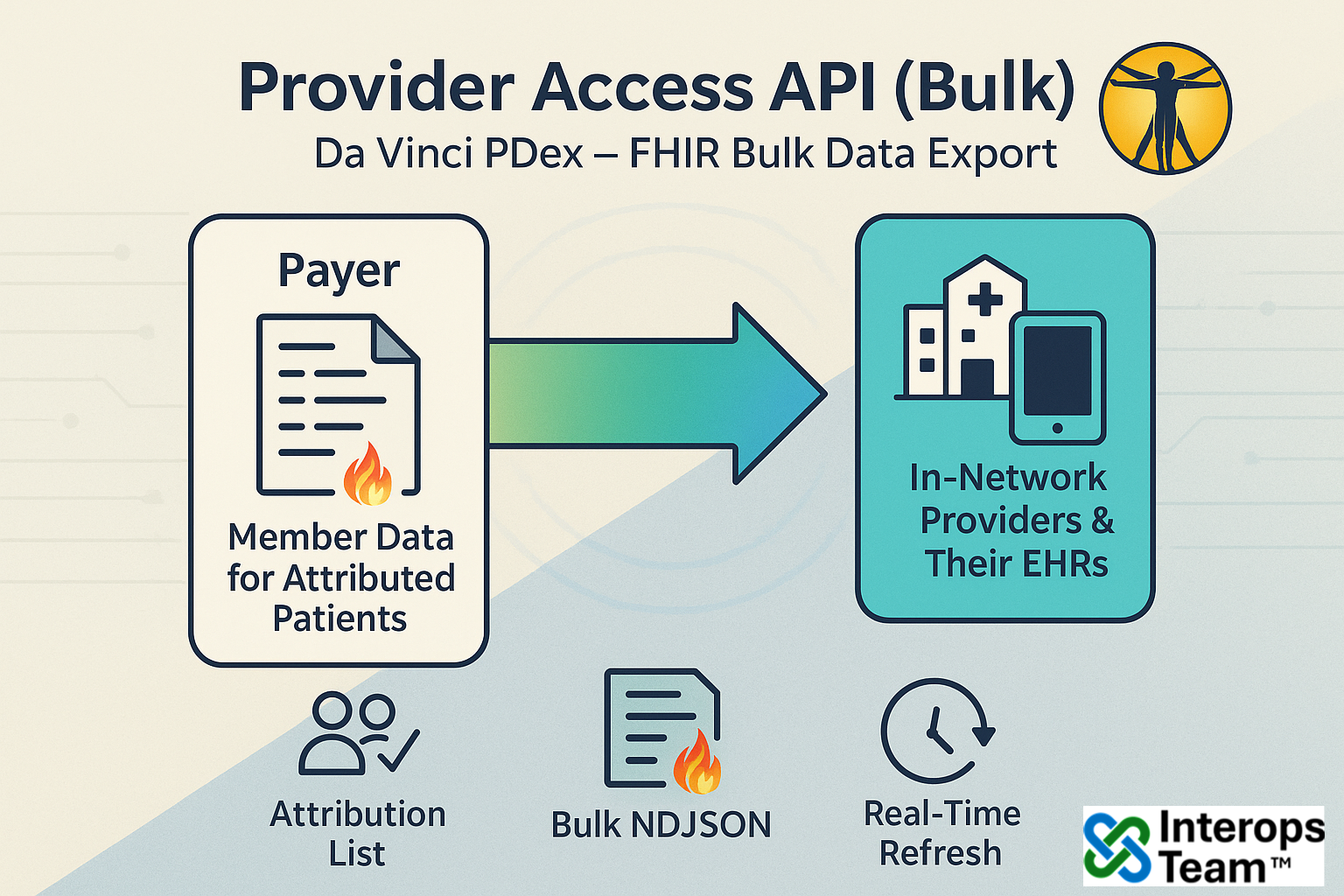
Providers often lack a complete view of a patient’s history when delivering care, especially when the patient has recently changed insurance plans or received services outside the health system. The Provider Access API enables payers to share relevant claims, coverage, medication, and clinical information with in-network providers using FHIR Bulk methods. This supports care coordination, risk identification, safety checks, and proactive management before or after the point of care.
Provider & Care Team Experience
- Visibility into services a patient received outside the local health system.
- Medication fill history to support reconciliation and adherence conversations.
- Historical conditions, procedures, and utilization patterns to support risk assessment.
- Improved care transitions and care management across payer and provider boundaries.
Technical & Standards Alignment
- FHIR R4 – PDex Profiles:
Patient,Coverage,ExplanationOfBenefit,Condition,MedicationDispense,AllergyIntolerance,Procedure,Observation, and related resources. - FHIR Bulk Data (NDJSON) exports for attributed patient populations.
- Attribution Lists (provider roster → patient panel mapping) based on plan contracts.
- Support for incremental updates using
_sinceparameters. - Secure data exchange using OAuth 2.0 client credentials or equivalent system-to-system trust.
Governance & Compliance
- Meets CMS 0057-F requirements for Payer-to-Provider API availability and reporting.
- Attribution logic documented and transparent to providers.
- Data minimization and adherence to “required for treatment” under HIPAA TPO.
- Audit logs for bulk exports, attribution changes, and data reconciliation.
- Versioned exports with timestamps, provenance metadata, and error reporting.
Value by Audience
Clinicians & Care Teams:
- Safer care through improved medication and condition visibility.
- Better context for diagnostic reasoning and chronic care management.
- Smoother transitions of care with fewer blind spots.
Care Management & Population Health:
- Early identification of rising-risk or high-risk members.
- Visibility into care gaps and historical utilization.
- More accurate risk scoring, outreach, and coordination.
IT & Architecture:
- Standard FHIR bulk interface instead of custom payer feeds.
- Repeatable ingestion and processing patterns for PDex data.
- Clear separation of export logic, attribution updates, and incremental refreshes.
Payers:
- Supports care coordination obligations under 0057-F.
- Reduces manual requests for patient history from providers.
- Standardized exports reduce duplicated integration work across EMRs.
Capabilities
- Bulk export of attributed patient populations using PDex profiles.
- Support for updates using incremental
_sincequeries. - Structured data for medications, conditions, encounters, and claims.
- Attribution list management and transparency.
- Integration with Provider Directory (Plan-Net) to map providers to networks and contracts.
Da Vinci Alignment
For detailed PDex payer-to-provider specifications, see the Da Vinci Payer Data Exchange (PDex) Implementation Guide, including attribution rules, bulk operations, and PDex resource profiles.
Optional Alternative Approaches
Providers may supplement bulk access with patient-level lookup tools, provider portals, or standalone SMART apps offered by the payer. These alternatives avoid large data ingestion while supporting clinicians who need patient context outside the point of care. Each approach builds on the same PDex data foundation but aligns differently with operational needs.