


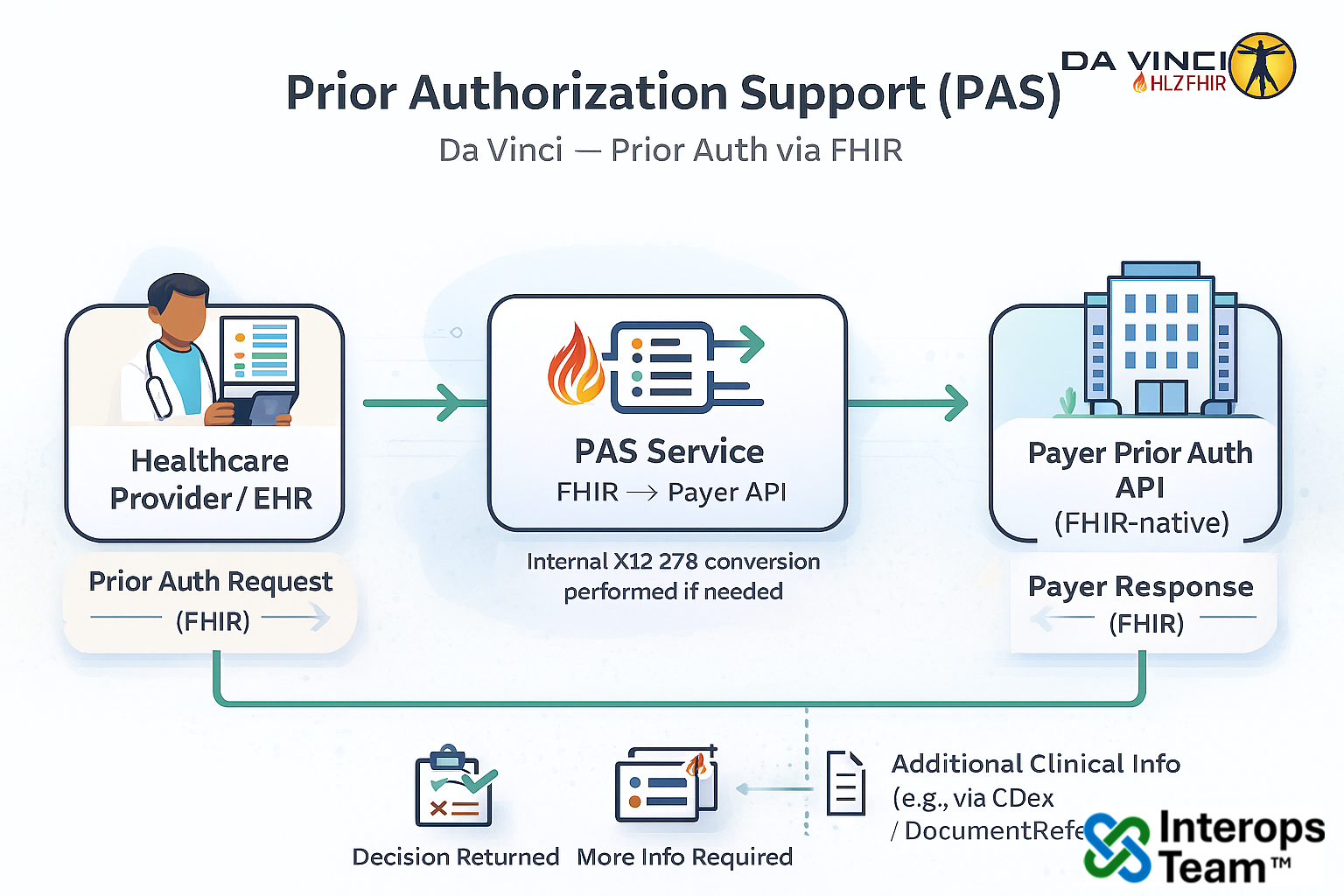
Prior authorization is one of the most burdensome administrative processes in healthcare. Missing documentation, manual faxing, long wait times, and repeated requests often delay care. The Prior Authorization Support (PAS) API provides an electronic pathway for submitting PA requests and receiving determinations in a standardized, structured format. PAS helps reduce friction by transmitting clinical data using FHIR or optionally with a hybrid fhir to X12 278 conversion. creating a much faster and more complete end-to-end experience.
Provider & Care Team Experience
- Ability to initiate a prior authorization directly from the EHR.
- Clinical data pre-populated from the patient record using FHIR resources.
- Real-time acknowledgment of submission and request status.
- Faster approvals when documentation is complete and structured.
- Reduced need for manual faxes or payer portal logins.
Technical & Standards Alignment
- FHIR R4:
Claim(as the PA Request),ClaimResponse(PA Determination),Coverage,Patient,QuestionnaireResponse, and supporting clinical resources. - X12 278: Support for X12 278 transactions generated from FHIR content to meet current prior authorization requirements.
- Complementary to CRD and DTR: CRD provides requirements; DTR assembles needed documentation; PAS submits it.
- Attachments:
Included as
DocumentReferenceresources (e.g., clinical notes, imaging, PDFs). - Sync or async patterns supported with polling via FHIR
ClaimResponse.
Governance & Compliance
- Meets CMS 0057-F requirements for electronic PA submission and timely response windows.
- Supports required metrics: turnaround times, approval/denial counts, pending durations.
- Ensures clinical data used for PA is consistent, versioned, and traceable.
- Payers must provide detailed denial reasons and next steps in the response.
- Audit trails for all submissions, attachments, adjudication steps, and outcomes.
Value by Audience
Clinicians & Ordering Providers:
- Submit PA requests without leaving the EHR.
- Reduced delays in care due to missing documentation.
- Clear guidance on what is needed for approval.
Care Management & Prior Auth Teams:
- Streamlined workflows with fewer follow-up requests.
- Ability to track status and fulfill payer documentation needs faster.
- Better visibility into which PAs are pending, approved, or denied.
Payers:
- More complete PA submissions at first review.
- Standardized data reduces manual chart collection.
- Faster adjudication and fewer repeat requests.
IT & Architecture:
- FHIR APIs for clinical data, X12, if needed, each used where appropriate.
- Reusable integration patterns across EHRs and payer systems.
- Clear separation between clinical content (FHIR) and transaction rules (X12 278).
Capabilities
- Submit PA requests electronically with pre-populated FHIR data.
- Attach clinical documents via
DocumentReference. - Receive determinations electronically through
ClaimResponse. - Support for pending, approved, denied, and “request for more information” statuses.
- Integration with CRD (requirements) and DTR (documentation).
Da Vinci Alignment
PAS is defined in the Da Vinci Prior Authorization Support (PAS)Implementation Guide, which specifies the FHIR-to-X12 mapping, claim/claimresponse workflows, attachment handling, and how PAS integrates with CRD and DTR to form an end-to-end prior authorization ecosystem.
Optional Alternative Approaches
Organizations may implement a simplified FHIR-native submission model also supported by Da Vinci PAS (vs X12 conversions) or use payer-hosted SMART apps for prior authorization when workflows need to stay outside the EHR. These alternatives may, in some cases, reduce EHR build complexity while preserving compliance with CMS timelines and documentation requirements.