


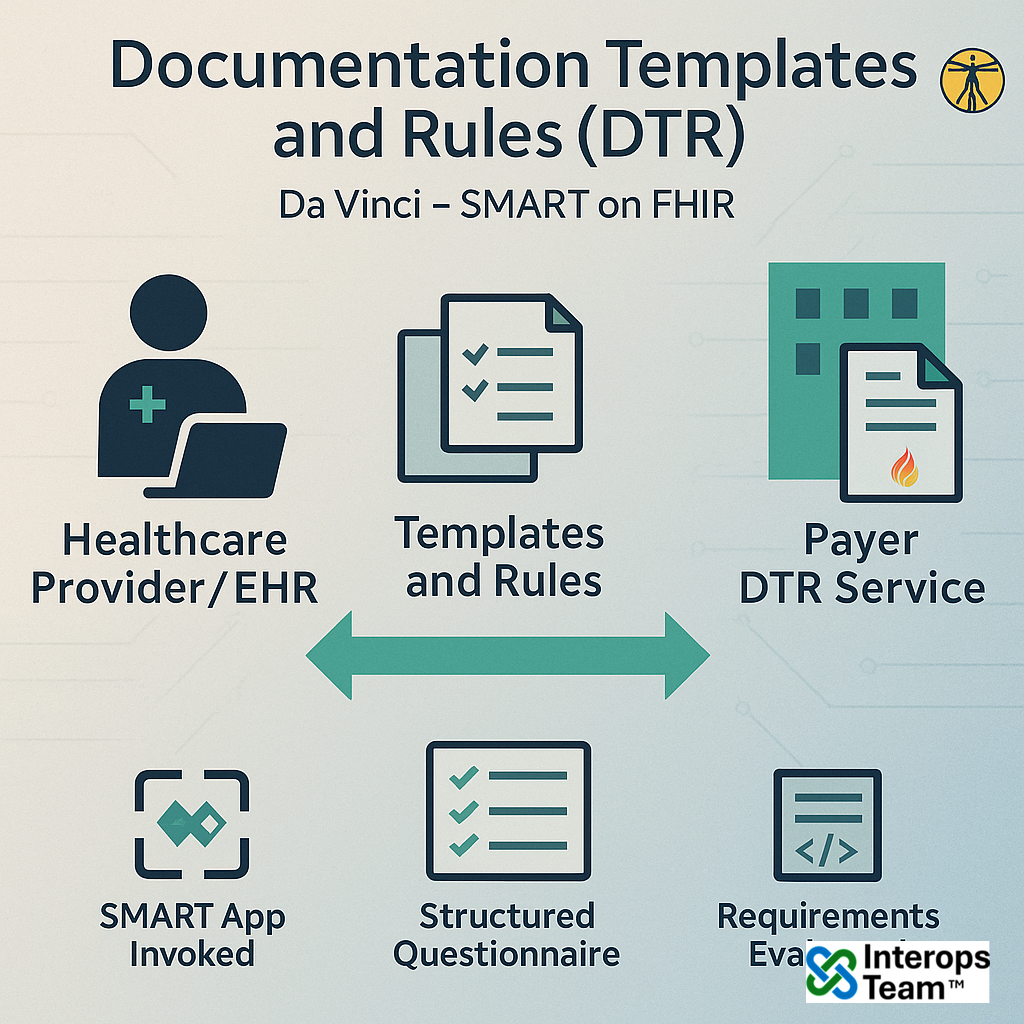
Many prior authorization delays occur because the provider’s initial submission is incomplete. Documentation Templates & Rules (DTR) aims to reduce this friction by helping clinicians assemble the right clinical information up front—using payer-defined rules, templates, and questionnaires. DTR can pre-fill data from the EHR, present missing requirements, and guide the user through a structured, repeatable workflow before a PAS submission is made.
Provider & Care Team Experience
- SMART app launched from a CRD card or standalone, displaying payer-required documentation.
- Automatic pre-population of available clinical data (conditions, vitals, labs, imaging results, etc.).
- Prompting for missing elements that the payer requires for medical necessity.
- Option to attach supporting documents or images as needed.
- Fewer rejections due to incomplete or missing information.
Technical & Standards Alignment
- SMART on FHIR App: payer-hosted or payer-approved application launched via CRD card.
- FHIR Resources: clinical data pulled directly from the EHR (e.g.,
Condition,Observation,Procedure,DocumentReference). - Questionnaire / QuestionnaireResponse: templates representing payer documentation rules.
- Rules Engine Support: payer-defined logic to determine what documentation is needed for a request.
- Output packaged as FHIR resources for use in PAS or other workflows.
Governance & Compliance
- Payers maintain versioned templates and rules, with clear effective dates.
- Templates must align with criteria used during prior authorization adjudication.
- Audit logs of template usage, data pre-fill, and user-entered responses.
- Support for Minimum Necessary by limiting data extraction to the required documentation set.
- Structured tracking of updates, corrections, and re-submissions.
Value by Audience
Clinicians & Ordering Providers:
- Reduced re-work and follow-up documentation requests.
- Clear visibility into what’s needed for approval.
- Pre-population minimizes manual data entry.
Care Management & Prior Auth Teams:
- More complete submissions at the start of the request.
- Faster turnaround times and fewer denials.
- Better alignment with payer-defined criteria.
Payers:
- Higher-quality, more complete PA requests.
- Reduced manual review time and fewer back-and-forth interactions.
- Less administrative burden and clearer clinical justification.
IT & Architecture:
- SMART app model decouples payer logic from the EHR itself.
- Reusable templates and rules across multiple providers and EHR systems.
- FHIR-based exchange simplifies integration with PAS and downstream workflows.
Capabilities
- SMART app launch from CRD or standalone workflows.
- Auto-fetch of relevant clinical data to pre-populate payer templates.
- Dynamic rules engine for determining missing documentation.
- Structured guidance for assembling clinical packets.
- Generation of QuestionnaireResponse and supporting documentation for PAS.
Da Vinci Alignment
Detailed workflows and technical models are defined in the Da Vinci Documentation Templates & Rules (DTR)Implementation Guide, including the SMART launch context, questionnaire profiles, and integration points with CRD and PAS.
Optional Alternative Approaches
Organizations may provide payer-hosted SMART apps that bypass complex rule engines and present a streamlined interface for required documentation. These approaches still comply with 0057-F but keep the user experience simpler while leveraging the same FHIR-based data pre-fill.