


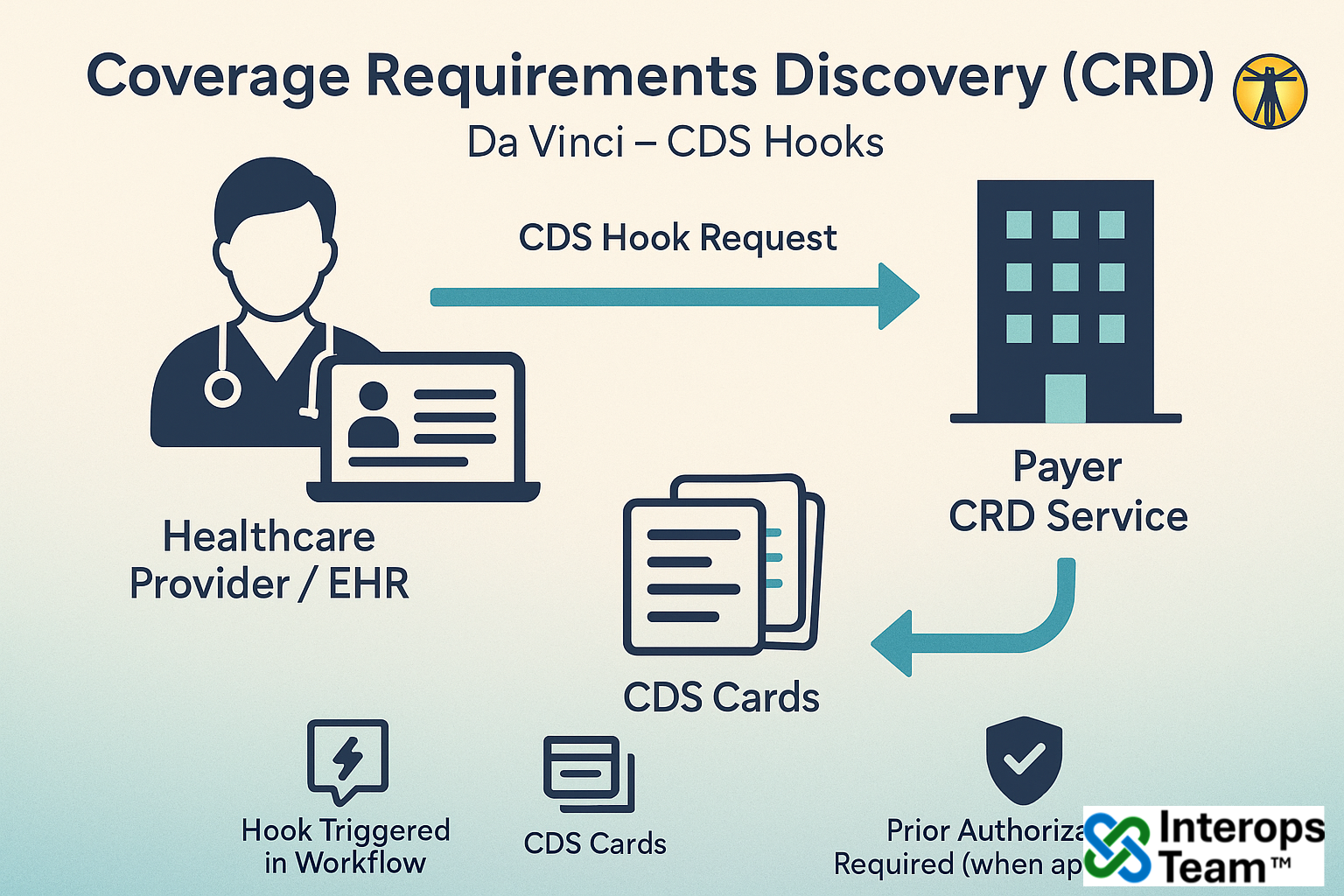
Prior authorization delays care, increases administrative burden, and creates unnecessary back-and-forth between providers and payers. Coverage Requirements Discovery (CRD) helps reduce this friction by giving clinicians real-time insight into potential coverage rules—such as prior authorization, step therapy, or medical necessity criteria—at the moment they place an order in the EHR. This allows care teams to plan appropriately, avoid denied claims, and initiate the right workflow the first time.
Provider & Care Team Experience
- Clear, actionable signals during ordering workflows (e.g., imaging, DME, labs, procedures).
- Non-intrusive alerts (“cards”) with payer-specific requirements.
- Links to documentation, alternative workflows, or coverage policies.
- Ability to launch next-step tools such as DTR or payer SMART apps directly from the card.
Technical & Standards Alignment
- CDS Hooks:
Triggers such as
order-select,order-sign, or other workflow events used by the EHR to call the payer. - FHIR R4 – PDex & PAS-related resources: patient, coverage, prior auth flags, diagnosis, and order context sent as part of the CDS request.
- SMART Launch Links: Cards may include links to payer-hosted SMART apps for deeper review.
- Responses follow standardized CDS Hooks “card” structures:
- Info Cards (guidance)
- Suggestion Cards (alternate pathways)
- App Launch Cards (initiate DTR or SMART workflows)
- Support for multiple payers and multiple policies without changing EHR workflows.
Governance & Compliance
- Supports CMS 0057-F requirements for real-time prior authorization transparency.
- Payer responsibility to ensure accuracy, timeliness, and versioning of requirements.
- Clear provenance and timestamping of recommendations.
- Policies must match what is used for adjudication to avoid discrepancies.
- Structured audit logs for requests, responses, and card selections.
Value by Audience
Clinicians & Ordering Providers:
- Fewer surprises and fewer retroactive documentation requests.
- Better alignment between clinical intent and payer policy.
- Reduced repeat orders or workflow interruptions.
Care Management & Prior Auth Teams:
- Early visibility into orders that may require authorization.
- More accurate routing to PAS or DTR workflows.
- Faster processing and fewer incomplete submissions.
Payers:
- Opportunity to guide providers earlier in the workflow.
- Reduced unnecessary or incomplete prior authorization requests.
- Improved member satisfaction with faster turnaround times.
IT & Architecture:
- Clear API surface using CDS Hooks and FHIR resources.
- No need to embed payer-specific logic inside EHR systems.
- Extensible design enabling multiple downstream workflows (DTR, PAS, SMART apps).
Capabilities
- Real-time evaluation of order context against payer coverage policies.
- Return of simple guidance, detailed rules, or app launch actions via cards.
- Support for multiple payer policies across various order types.
- Initiation of next steps such as DTR or PAS based on card selection.
- Logging of card actions and recommendations for audit and performance metrics.
Da Vinci Alignment
CRD is defined in the Da Vinci Coverage Requirements Discovery Implementation Guide, which specifies CDS Hooks triggers, request and response structures, and alignment with PDex and Prior Authorization workflows.
Optional Alternative Approaches
Organizations may enhance CRD with payer-specific SMART apps or simplified “coverage lookups” that operate outside the ordering workflow. These alternatives allow clinicians or care teams to check requirements prior to ordering, without introducing additional EHR complexity, while still leveraging the same coverage knowledge base.