


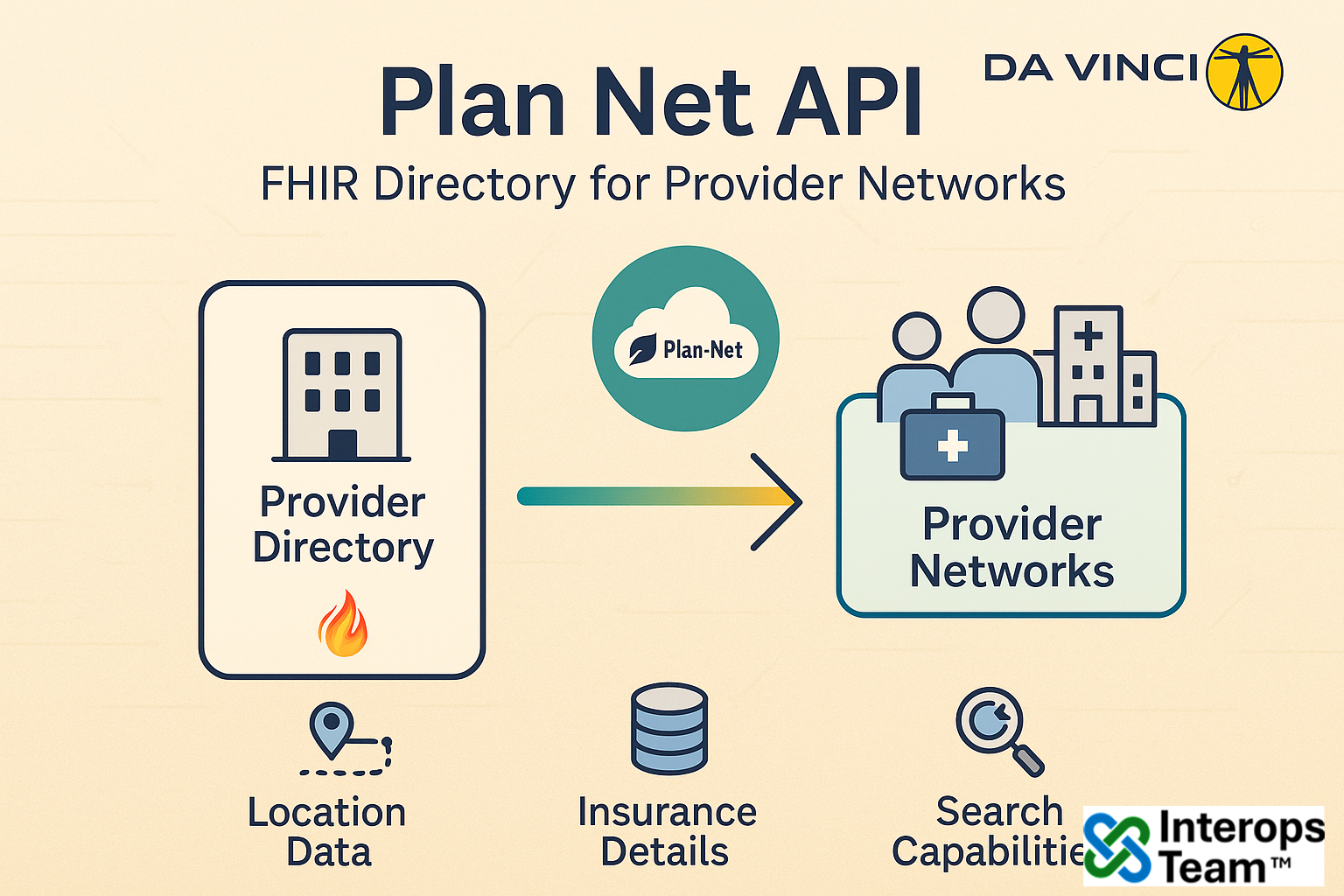
Finding an in-network provider who actually matches a patient’s needs—specialty, location, language, telehealth options, and accepting-new-patient status—is still harder than it should be. Provider information is often scattered across static directories, PDF lists, and call centers, with frequent mismatches between what’s published and what’s real. The Plan-Net API exposes a structured, machine-readable provider directory that apps, portals, and search tools can use to surface accurate, filterable provider options in real time.
Patient & Member Experience
- Search for in-network providers by specialty, location, language, gender, and telehealth availability.
- Filter by plan/network participation, accepting new patients, and office hours.
- See clear contact details, locations, and links to practice websites or portals.
- Reduced reliance on call centers and static PDFs that quickly go out of date.
Clinician / Referral Experience
- Easily locate in-network specialists and facilities for referrals.
- Filter by clinical focus, subspecialty, and service offerings.
- Align referrals with patient coverage, reducing out-of-network surprises.
- Support care coordination and closed-loop referral workflows.
Technical & Standards Alignment
- FHIR R4 – Da Vinci PDex Plan-Net:
Organization,Practitioner,PractitionerRole,Location,HealthcareService,Network,InsurancePlan, andEndpoint. - RESTful FHIR APIs to search providers, organizations, and locations with rich filters.
- Support for networks and plans to constrain “in-network” results.
- Standardized coding for specialties, services, and identifiers (e.g., NPI, taxonomy codes).
- Designed to be publicly accessible (no PHI) for websites, apps, and broker tools.
Governance & Compliance
- Meets CMS 9115-F requirements for public provider directory access.
- Supports timely updates when providers join/leave networks or change locations.
- Alignment with internal credentialing, contracting, and provider data management sources.
- Versioning and audit of changes to provider, network, and plan participation records.
- Clear ownership and stewardship of provider data quality across payer systems.
Value by Audience
Patients & Members:
- Faster, more accurate “find a doctor” experiences.
- Reduced risk of accidentally booking with out-of-network providers.
- Ability to find care that matches language, access, and preference needs.
Clinicians & Care Teams:
- Reliable in-network referral options at the point of care.
- Better alignment between referral decisions and patient coverage.
- Support for coordinated care and shared-care models.
IT & Architecture:
- Standard API surface for provider search instead of custom feeds or scraped sites.
- Single source of truth for network participation that can power multiple channels (web, mobile, broker tools).
- Integration with enterprise Provider Data Management (PDM) and credentialing systems.
Payers:
- Regulatory compliance for public directory transparency.
- Reduced directory-related complaints and call volume.
- Better visibility into network composition and access gaps.
Capabilities
- Search providers by specialty, distance, language, gender, and telehealth options.
- Filter by plan/network to show in-network results only.
- Expose detailed practice locations, contact info, and hours of operation.
- Return network and plan participation for use in enrollment and comparison tools.
- Surface endpoints for electronic transactions (e.g., FHIR, Direct, eFax) where applicable.
Da Vinci Alignment
For profiles, vocabulary, and search patterns, see the Da Vinci PDex Plan Net Implementation Guide, which defines the provider directory resources, relationships, and queries used to represent payer networks in FHIR.
Optional Alternative Approaches
Organizations may extend Plan-Net with richer Provider Data Management functions, integrating credentialing, contracting, quality scores, and patient feedback. These extensions support internal analytics, network design, and digital front door strategies while the core Plan-Net API remains the standards-based public directory surface for external consumers.