


With the app economy has come the Internet of Things (IoT), “devices on FHIR,” and a wave of consumer wearables. Apple Watch, Fitbit, Garmin, Samsung, Oura, WHOOP, and others all have their own platforms, APIs, and connection patterns for talking to a healthcare organization.
As more patients buy these devices or install their companion apps, care teams and program leaders are understandably interested in using that data, tracking trends, monitoring risk, and in some cases even filing it into the patient’s legal medical record.
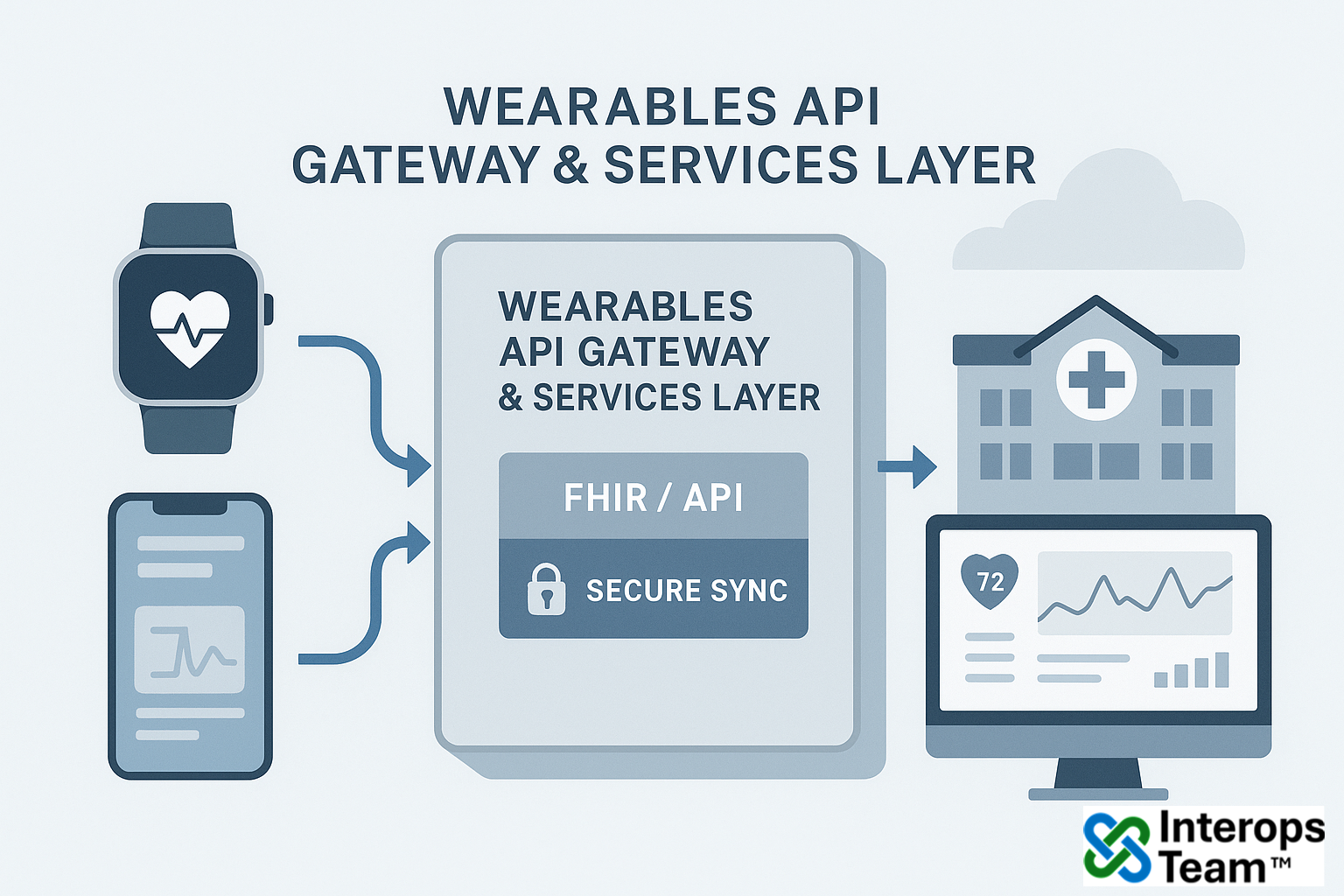
Instead of building one-off integrations for each vendor, organizations can stand up a dedicated API services layer that sits in front of all wearable connections. This “wearable gateway” becomes a single control point for onboarding devices, enforcing security and consent, and feeding normalized data into the broader enterprise services layer.
This gateway is the single, managed front door for all patient-originated wellness data. It abstracts auth, rate limits, retries, and versioning, then hands off clean, provenance-tagged payloads to normalization and clinical routing without hardwiring app-specific logic into downstream systems.
Benefits
- Centralized connector configurations: All wearable-device integrations are managed in one place rather than being scattered across multiple apps or teams.
- Single ingestion layer: One normalized entry point for wearable data instead of maintaining many point-to-point connections.
- Unified OAuth and consent enforcement: A consistent model for authentication, token refresh, and patient permissions across all vendors.
- Centralized certificate management: Streamlines onboarding, rotation, and security for all device vendors and partner APIs.
- Centralized operations and monitoring: A single dashboard to track device activity, failures, throughput, performance, and operational health.
- Consistent audit and traceability: One audit trail for all PGHD flows, centralizing compliance, provenance, and HIPAA review.
Great for:
- Security or Compliance Officers: Enforce perimeter protections with WAF, mTLS, and IP allowlists. Monitor incoming events with full audit trails and scope-based consent enforcement.
- Production Support and IT Operations: Gain observability into mobile uplinks with retry/backoff, idempotency, and request tracing. Use dashboards to monitor throughput, latency, and drop rates.
- IT Managers and Platform Architects: Centralize ingestion service for all patient-facing wellness data. Abstract auth, throttling, and versioning while handing off clean payloads to downstream services.
What’s broken today
Organizations usually start small—one digital-health initiative, one device partner. Then the program expands and suddenly:
- You’re maintaining multiple wearable integrations that all break differently.
- Metrics don’t align (e.g., “sleep” ≠ “sleep stage” ≠ “sleep session”).
- Vendors push silent API changes without backward compatibility.
- OAuth token rules vary by device vendor; refresh rules are inconsistent.
- Clinical teams don’t trust the numbers because “consumer accuracy” is a real issue.
- Legal asks where your audit trail is for PGHD.
And because each integration lives in its own silo, care teams end up with five dashboards and no unified patient narrative. This is the predictable failure path of wearable programs.
What a Patient Wearable API Gateway actually does
This gateway provides a single, controlled entry point for all wearable and patient-facing device data. At its core, it handles:
1. Ingestion & vendor API brokering
- Manages connections to Apple, Fitbit, Garmin, Samsung, Oura, WHOOP, etc.
- Handles vendor-specific authentication (OAuth2, PKCE, app tokens).
- Pulls or receives webhook notifications for new data.
2. Normalization & standardization
- Maps raw JSON objects into consistent internal models.
- Normalizes units (steps, calories, HR zones, SpO₂ trends, HRV).
- Converts to FHIR Observation with appropriate LOINC/SNOMED where applicable.
- Flags suspicious or out-of-range values for downstream workflows.
3. Consent & identity binding
- Binds device accounts to patient identities using OIDC, patient portal SSO, or your CRM/portal identity.
- Enforces patient-controlled sharing/permissions.
- Records every consent decision for compliance.
4. Audit, provenance & traceability
- Tracks source device, vendor, timestamp, revision history.
- Creates a defensible provenance record for HIPAA and clinical review.
- Supports “break glass” or revocation audits for PGHD flows.
5. Routing into clinical systems
- Routes normalized PGHD to your EMR (FHIR ingest, HL7v2 ADT/ORU, file drops, API calls).
- Feeds analytics pipelines (S3/Blob storage, EDW, Delta Lake).
- Supports care-management and RPM vendors with consistent data models.
Why providers care
Providers need wearable data only when it improves care—not when it becomes another interface to chase. A good gateway delivers:
- One place for all PGHD instead of 10 separate dashboards.
- Normalized vitals that don’t confuse clinicians.
- FHIR-native data that flows into clinical context.
- Audit trails that satisfy compliance without heroic logging.
- No device vendor lock-in—swap vendors without re-architecting.
This is essential for RPM programs, CHF/COPD monitoring, diabetes management, fall-risk detection, and post-discharge care transitions.
Why payers care
Payers increasingly use wearable data for incentives, care-gap closure, and risk-based outreach. But without a gateway:
- Your data science team is ingesting five proprietary JSON schemas.
- Your fraud/waste team has no reliable audit of device data.
- Your incentive programs break when vendors change APIs.
- There’s no clean handoff back to the provider’s clinical workflow.
A gateway solves upstream chaos and makes downstream analytics more trustworthy.
Architecture at a glance
Most organizations structure this as a lightweight, cloud-hosted, event-driven service:
- API layer: OAuth2 + vendor connectors
- Ingestion layer: webhook receivers, polling jobs
- Normalization engine: mapping tables, LOINC/SNOMED transformers
- Identity & consent: OIDC, patient portal SSO
- Provenance & audit: timestamps, device IDs, version control
- Routing: FHIR ingest API, HL7 interfaces, analytics pipelines
This isn’t an ESB replacement—it’s a domain-specific gateway designed for chaotic consumer-device ecosystems.
Where this fits in your overall architecture
This gateway usually sits between:
- Your Patient App / Portal
- Your Identity Provider (OIDC/SSO)
- Your FHIR Server or EMR ingestion layer
- Your care-management or RPM vendor
It becomes the consistent, trusted interface for PGHD—whether you onboard 100 patients or 100,000.
Bottom line
Consumer wearable data is here to stay, but the ecosystem is a mess. A Patient Wearable API Gateway gives you a controlled, compliant, clinically aware path to ingest PGHD at scale without duct-taping device-specific integrations. It’s the difference between “we support wearables” and actually supporting them in a way clinicians trust and auditors can defend.
Next steps:
If you’re exploring wearable data workflows or need help designing a patient-facing gateway architecture, we can walk through real-world implementation models, common pitfalls, and how this fits into your broader interoperability strategy.