


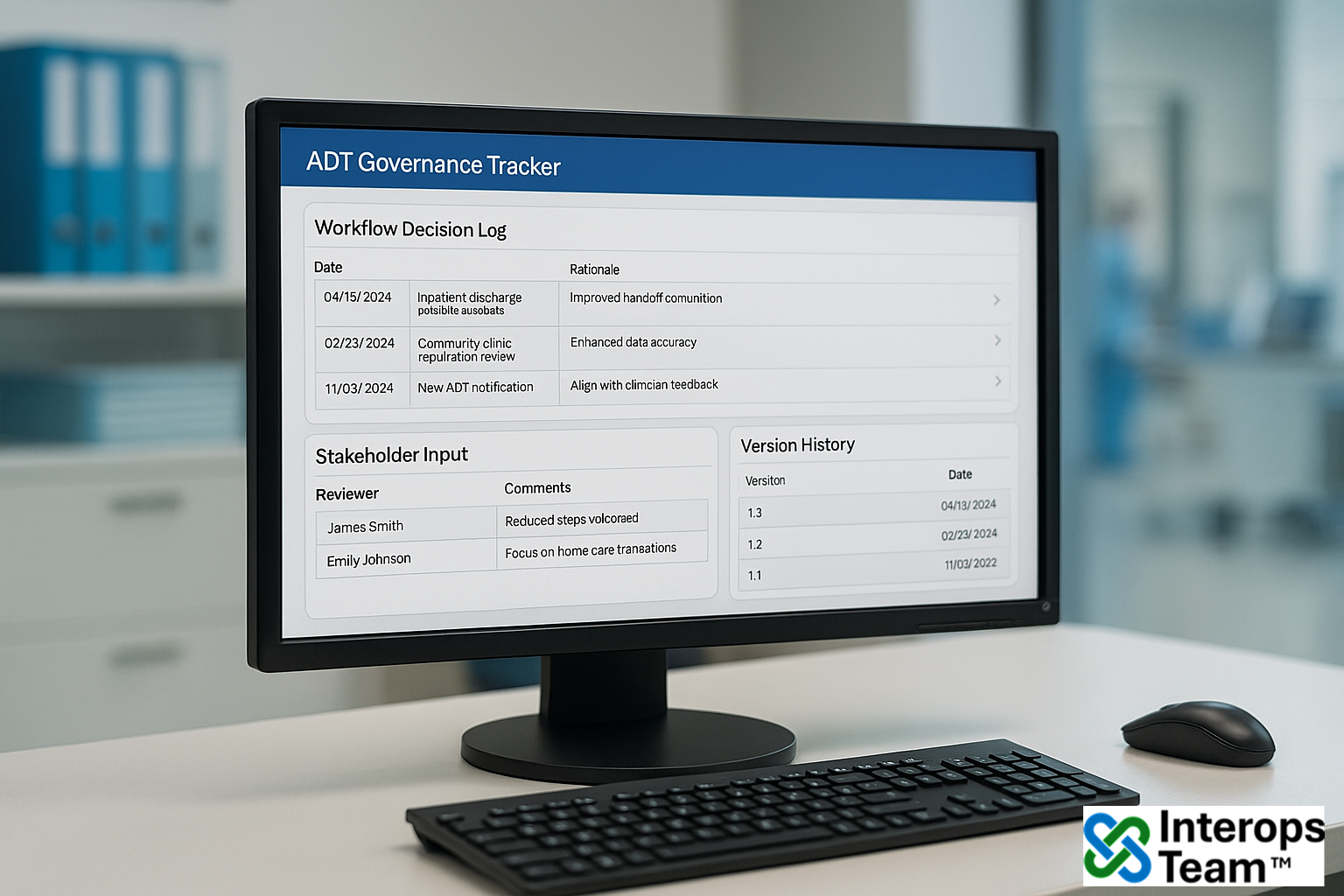
The ADT Governance Tracker centralizes documentation of all admission, discharge, and transfer (ADT) workflow changes across inpatient and ambulatory environments. It serves as a governance and accountability layer, tracking decisions, capturing stakeholder input, and preserving version history, so the rationale behind each ADT redesign remains visible, traceable, and defensible over time.
This tool documents the “why” behind every ADT change: decision owners, alternatives considered, affected downstream workflows, and compliance implications. By maintaining structured decision logs and review artifacts, it creates a living governance record that persists through staffing transitions, audits, and continuous improvement cycles.
Benefits
- Ensures transparency: Captures the full decision trail, including rationale, stakeholder input, and impact notes.
- Supports defensibility: Provides audit-ready evidence of change management practices for internal or regulatory review.
- Improves alignment: Keeps technical build, policy intent, and operational execution synchronized across departments.
- Preserves institutional memory: Maintains continuity through staffing changes and multi-phase redesign projects.
- Enables cross-functional collaboration: Serves as a shared record for HIM, operations, IT, and compliance teams.
Capabilities
- Decision logging: Records ADT workflow decisions with timestamps, responsible parties, and rationale for change.
- Stakeholder feedback capture: Tracks review cycles, sign-offs, and comments from operations, compliance, and build teams.
- Version and dependency tracking: Links decisions to specific workflow iterations, related ADT events, and dependent systems.
- Change summary reports: Generates audit-ready snapshots of recent changes, reviewers, and outcomes.
- Cross-department governance view: Provides a unified perspective across inpatient and ambulatory ADT redesign efforts.
- Policy alignment checks: Flags discrepancies between proposed logic and documentation or access policies.
Great for
- Clinical Operations and HIM Leaders: Maintain a living record of ADT redesigns, rationale, and stakeholder input for continuous operational improvement.
- Compliance and Audit Teams: Ensure defensible traceability of workflow changes with structured decision logs, approvals, and version control.
- Build and Configuration Analysts: Align ADT event logic with policy and workflow design using documented dependencies and change history.
- Governance and Change Control Boards: Review, approve, and certify workflow modifications using centralized records of stakeholder review and impact assessment.
Integration & Standards Alignment
- Integrates with change management and ticketing systems (e.g., ServiceNow, Jira, or EMR change logs)
- Supports HL7 v2.x and FHIR
EncounterandTaskevent traceability - Maps to IHE ITI Audit Trail and Node Authentication (ATNA) for audit integrity
- Complies with HIMSS and AHIMA governance best practices for change documentation
- HIPAA-aligned under 45 CFR §164.530(j) for documentation and policy retention
Outcome Metrics
- ↓ reduction in undocumented workflow changes
- ↑ improvement in cross-department decision transparency
- ↑ faster audit preparation through automated version tracking