


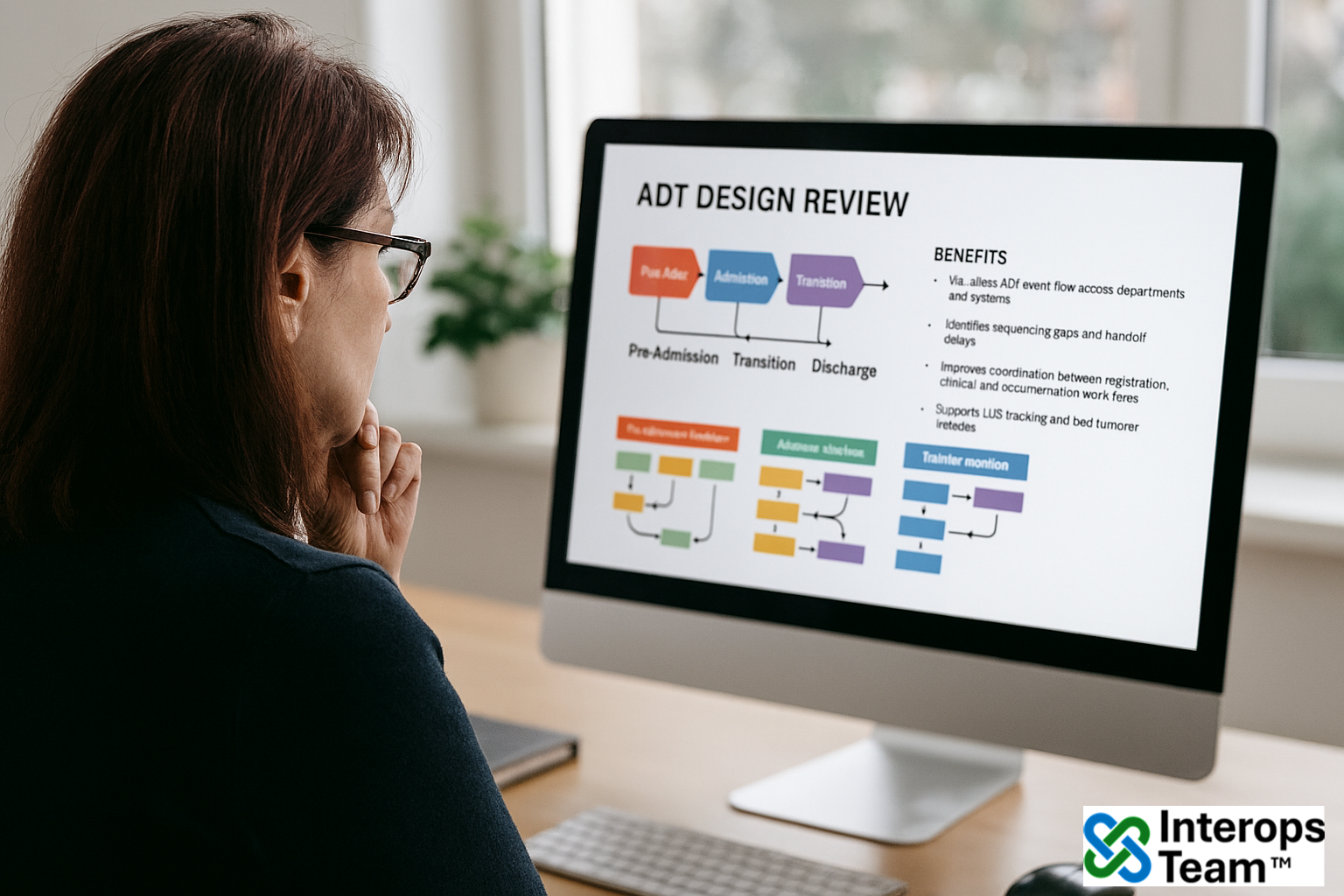
The ADT Design Review tool helps clinical operations, HIM, and registration teams evaluate and refine admission, discharge, and transfer logic across inpatient and ambulatory settings. It focuses on sequencing, dependencies, and throughput friction, ensuring that every ADT trigger aligns with rounding lists, documentation timing, access rules, and downstream workflows before changes go live.
Designed as a facilitation utility for multidisciplinary working sessions, it enables users to map current vs. target event sequences, annotate handoff pain points, and visualize patient flow across departments. This structured approach drives clarity, cross-team consensus, and measurable improvements in patient throughput and operational safety.
Benefits
- Reveals inefficiencies: Visualizes ADT event flow and handoff points to highlight sequencing gaps, delays, and redundant triggers.
- Improves coordination: Bridges registration, clinical, and documentation teams around shared ADT logic and timing.
- Supports operational optimization: Informs LOS tracking, bed turnover, and rounding workflows with event-level insights.
- Reduces build risk: Aligns upstream and downstream stakeholders before EMR configuration changes.
- Enhances compliance and governance: Ensures ADT event structure supports access control, auditability, and patient safety standards.
Capabilities
- Event sequencing visualization: Displays admission, transfer, and discharge triggers in time-ordered flow diagrams.
- Cross-department mapping: Links ADT workflows between registration, bed management, nursing, and HIM systems.
- Annotation and review tools: Capture comments, notes, and redesign recommendations directly on workflow maps.
- LOS and throughput modeling: Simulate delays and predict downstream impact on bed turnover and documentation timing.
- Pre-build validation: Generate target-state ADT event sets and configuration recommendations for EMR teams.
Great for
- Clinical Operations Leaders: Redesign ADT workflows to improve throughput, coordination, and alignment with rounding and documentation timing.
- HIM and Registration Teams: Identify sequencing gaps and handoff delays across departments to reduce friction and improve patient flow.
- Multidisciplinary Workgroups: Facilitate collaborative sessions to map current vs. target ADT logic and annotate build requirements before implementation.
- Clinical Informatics and EMR Analysts: Validate configuration changes and ensure event logic supports clinical and operational objectives.
Integration & Standards Alignment
- Supports HL7 v2.x ADT event models (A01, A02, A03, A08, A11, A13, A40)
- Maps to FHIR
EncounterandEpisodeOfCarefor modern workflows - Aligns with IHE PCC and ITI profiles for patient movement and event orchestration
- Configurable to site-specific LOS, access, and rounding list logic
Outcome Metrics
- ↓ reduction in ADT-related workflow errors
- ↑ improvement in bed turnover visibility
- ↑ faster cross-department consensus on workflow redesigns