


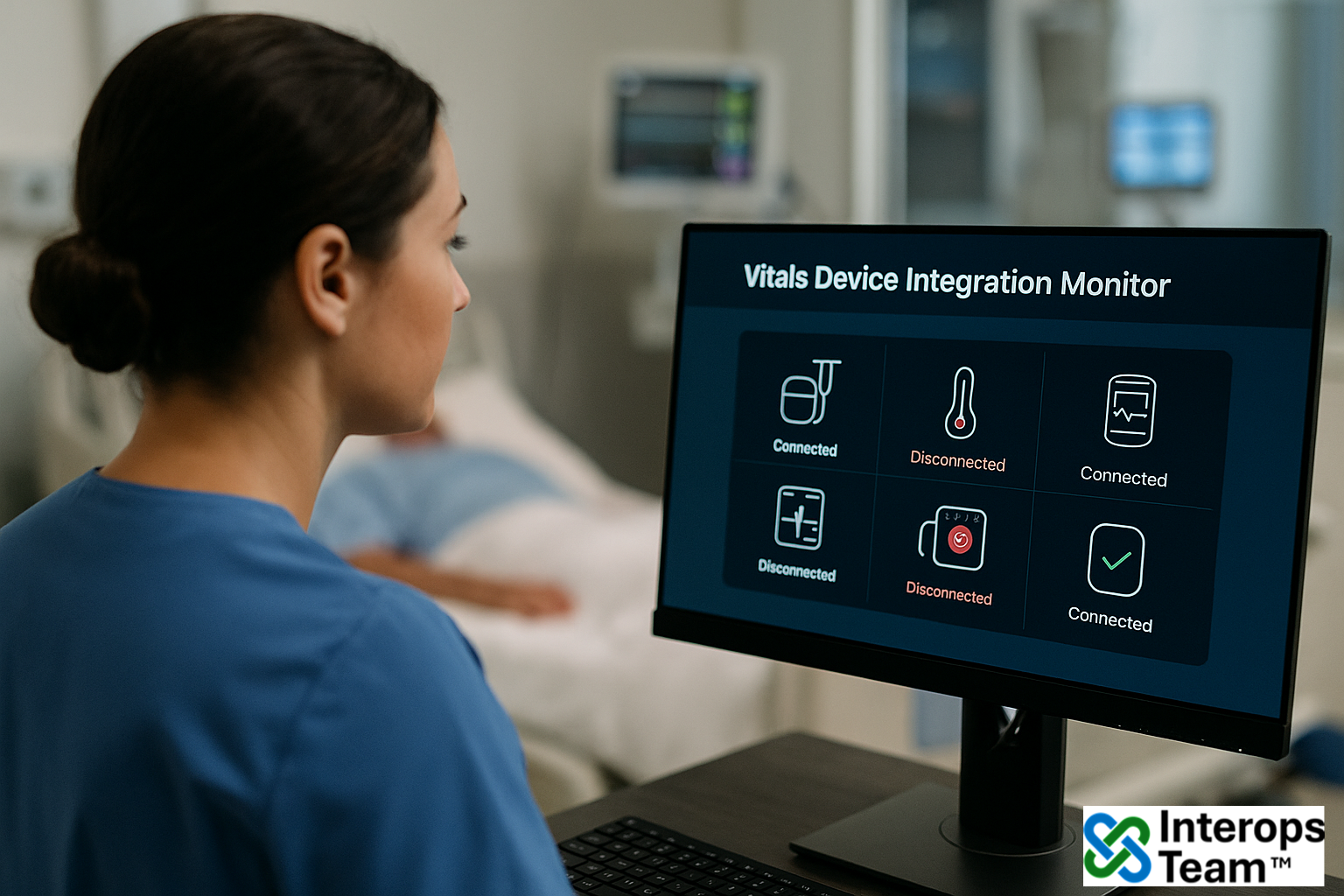
The Vitals Device Integration Monitor continuously audits the flow of bedside vitals from patient care devices into the EMR. It detects missing, delayed, or mismatched data uploads, helping nursing teams, informatics, and clinical engineering resolve issues before patient safety or documentation integrity is compromised.
Why it matters
Vitals data is foundational to early warning systems, sepsis detection, and patient monitoring. When devices fall offline, become unassigned, or transmit incomplete data, care teams lose the ability to detect subtle changes in condition. This tool acts as a watchdog for connectivity and data fidelity, ensuring nurses can trust their flowsheets and intervene early when deterioration patterns emerge.
Benefits
- Protects against missed deterioration signals: Detects gaps in vitals cadence that could mask clinical decline.
- Improves trust in flowsheet data: Ensures every reading is time-stamped, attributed, and linked to the correct patient and device.
- Speeds troubleshooting: Identifies device disconnections, stale interfaces, or bed reassignments in real time.
- Strengthens documentation integrity: Provides defensible audit logs for nursing and quality review.
Capabilities
- Device event monitoring: Tracks IHE PCD-01, PCD-04, and PCD-10 message flows to verify ongoing connectivity.
- Vitals cadence detection: Flags missing or irregular readings against expected measurement intervals.
- Patient-device association validation: Alerts when vitals are uploaded under incorrect or ambiguous patient assignments.
- Unit dashboards and notifications: Visualizes connectivity status and data latency by room, device, or patient.
- Audit and forensics mode: Captures complete event chains for QA, root-cause analysis, or regulatory review.
- Cross-domain integration: Feeds anomalies to nursing dashboards, sepsis detection tools, and biomedical monitoring systems.
- FHIR interoperability: Aligns device and observation data using
Device,Observation,Patient, andAuditEventresources.
Great for:
- Nursing Teams & Unit Supervisors: Detect stale devices, failed uploads, and mismatched assignments to maintain confidence in trending and early warning scores.
- Clinical Engineering & Informatics Analysts: Monitor IHE PCD event traffic, surface connectivity gaps, and accelerate device remediation and interface tuning.
- Quality & Patient Safety Officers: Correlate device uptime and data completeness with deterioration prevention metrics for defensible quality oversight.
- Biomedical & IT Operations: Track performance of gateways, HL7 interfaces, and device networks to maintain high availability and compliance.
Integration & Standards Alignment
- FHIR R4 compliant (
Observation,Device,AuditEvent,Patient) - Supports IHE PCD profiles (PCD-01, PCD-04, DEC, ACM) for device event communication
- Audit-ready via IHE ATNA with configurable retention policies
- Interfaces with EMR vitals flowsheet modules and device middleware (Capsule, Cerner CareAware, etc.)
- Real-time notification API for nurse call systems or escalation dashboards