


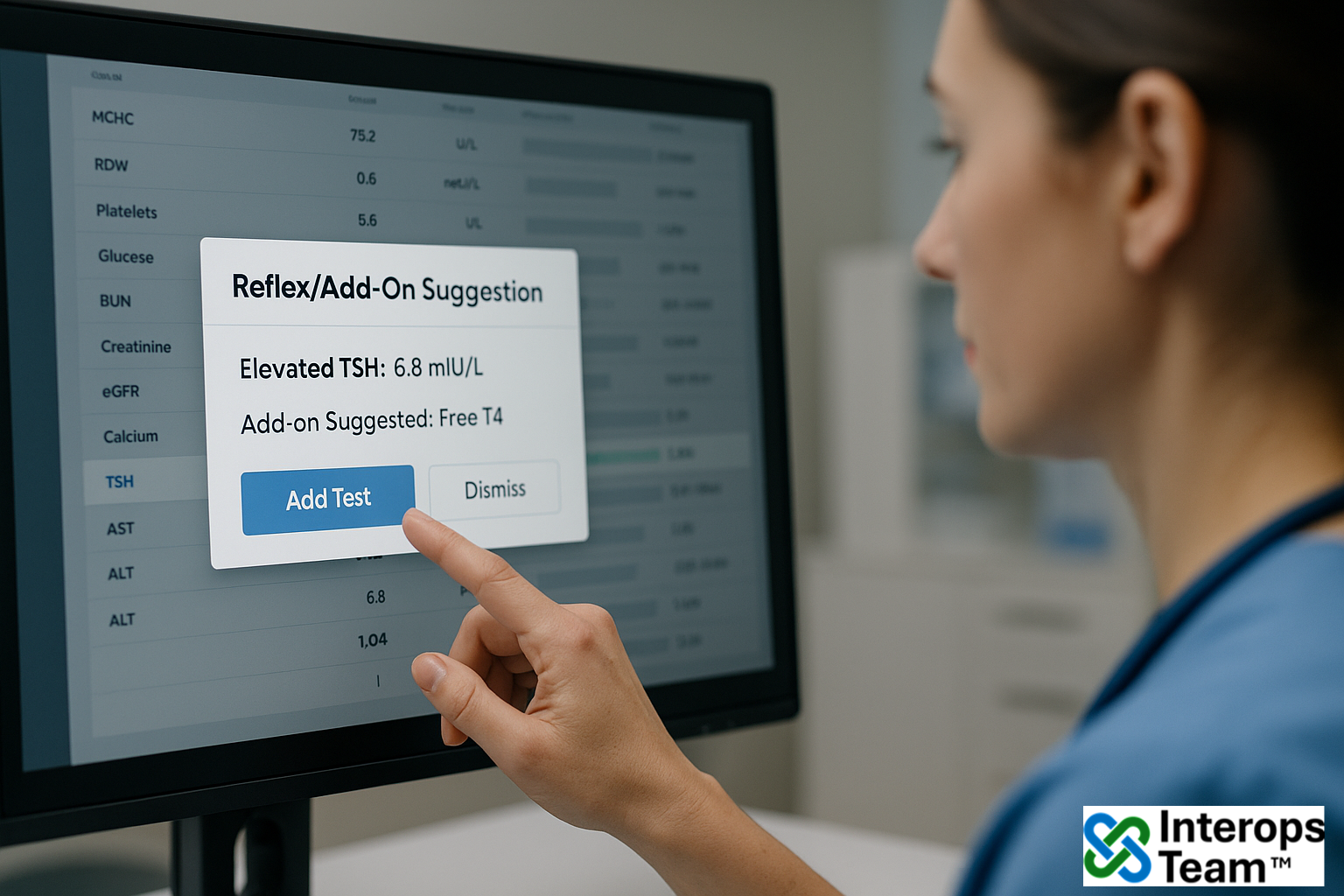
The Reflex & Add-On Order Assistant intelligently prompts clinicians during result review or order entry when follow-up testing is clinically indicated. It uses EMR-side decision support logic, HL7v2 result triggers, and specimen timing metadata from the LIS to minimize redraws and improve continuity of care, without taking over lab-side routing or viability management.
When qualifying results arrive (e.g., elevated troponin, abnormal CBC differentials), CDS Hooks or EMR rules trigger contextual prompts offering one-click add-on ordering options tied to the original specimen or encounter. This approach enhances clinical responsiveness while ensuring defensible, audit-backed order workflows fully contained within the EMR.
Benefits
- Reduced redraws and patient discomfort: Enables additional testing from existing specimens when clinically appropriate.
- Faster, more complete decisions: Surfaces add-on opportunities at the point of review or ordering.
- Improved utilization management: Reduces redundant testing and unnecessary specimen collection.
- Embedded clinical governance: Applies policy-driven logic within EMR decision support layers.
Capabilities
- CDS Hooks integration: Triggers at result posting or order entry to evaluate add-on opportunities.
- Rule-driven recommendations: Uses configurable EMR-side logic referencing HL7v2 or FHIR result events and specimen timing data.
- One-click add-on ordering: Allows clinicians to accept, modify, or decline reflex recommendations from within the EMR.
- Audit and analytics: Tracks acceptance rates, decision overrides, and timing windows for continuous improvement.
- Specimen viability checks: References LIS-provided metadata for same-day add-ons or reflex opportunities.
Great for
- Clinical Informatics and EMR Analysts: Configure rule sets and event triggers to surface add-on opportunities during result review and order entry.
- Providers and Care Teams: Respond quickly to abnormal results with one-click follow-up ordering options that reduce delays and redraws.
- Compliance and Decision Support Architects: Govern reflex logic and maintain audit-ready CDS Hooks documentation aligned with institutional policy.
- Quality and Operations Leaders: Monitor utilization trends and ensure reflex ordering supports both efficiency and patient safety goals.
OBR/OBX events, FHIR Observation triggers, and CDS Hooks decision support, ensuring safe and auditable follow-up ordering directly inside the EMR.