


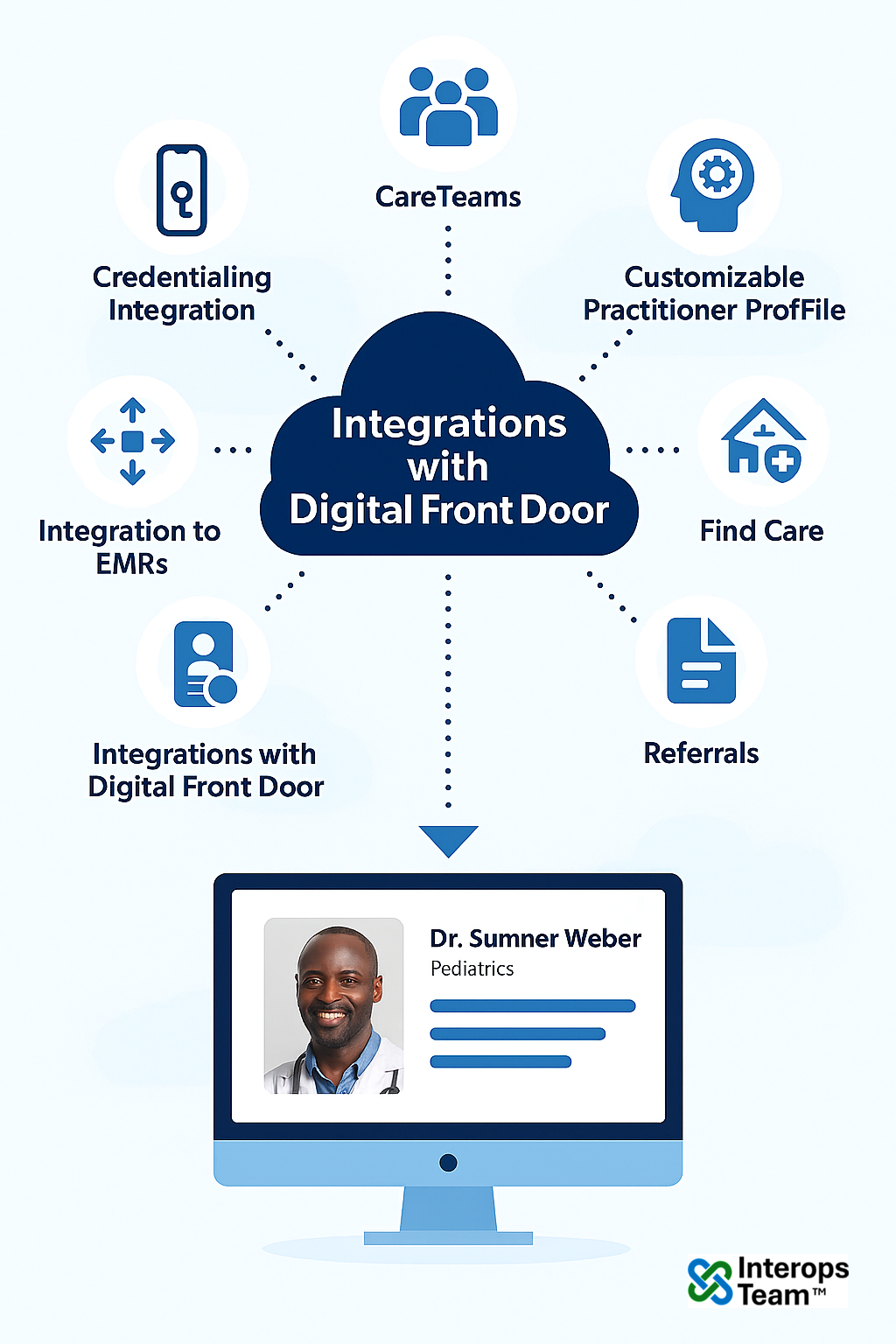
The Provider Data Management (mCSD Directory Hub) gives the organization one governed source of truth for practitioner, location, service, and care team data. It exposes a standards-based provider directory backed by FHIR and IHE mCSD, so digital teams, EMR-side workflows, and downstream systems don’t have to scrape, re-key, or hard-code provider details.
What it solves
Most health systems keep provider information in multiple places—credentialing, HR, scheduling, EMR, marketing sites, and homegrown lists. That fragmentation makes “find care,” referrals, and care coordination frustrating for both patients and staff. This hub creates a single, API-driven backbone for provider and location data that everyone can use.
Core capabilities
- Standards-based directory: Uses FHIR
Practitioner,PractitionerRole,Organization, andLocationaligned with IHE mCSD for care services discovery. - Extended practitioner profiles: Adds custom fields for bio, specialties, languages, telehealth availability, accessibility, and patient-friendly attributes used by digital front doors.
- Credentialing integration: Pulls authoritative identifiers, licensure, and status from the credentialing system, reducing manual updates and mismatches.
- Service and program modeling: Captures which locations and providers offer which services, hours, and modalities (in-person, virtual, home-based).
- Referral and care team directory: Exposes which providers, clinics, and programs accept referrals for specific services or populations, and how they prefer to be contacted.
- Governance and audit: Tracks who changed what, when, and why using FHIR
ProvenanceandAuditEvent, so corrections are traceable.
Referrals and care coordination
Because the hub already knows about providers, locations, and services, it becomes the natural backbone for referrals and care teams:
- Referral routing: Use directory attributes (insurance participation, service type, age range, language, location, telehealth) to route referrals to the right providers or clinics.
- Care team visibility: Represent primary care, specialists, and key roles with FHIR care team structures, so care coordination tools can show “who is on this patient’s team.”
- Program and clinic panels: Flag providers or clinics as accepting new patients, or tied to specific programs, for both internal coordination and digital “find care” flows.
- Downstream reuse: Referral management apps, care coordination platforms, CRMs, and contact centers all draw from the same PDM directory instead of maintaining their own lists.
How it’s used
- Digital experience teams: Power “find a doctor,” “find a clinic,” and program finders on web and mobile, with reliable filters that match real operational rules.
- Care coordination and referrals: Use a single directory to search for appropriate referral targets and to understand existing care team relationships.
- Enterprise applications: Treat the PDM hub as the shared directory for outreach, call centers, care management, and analytics.
Integration & standards alignment
- FHIR R4: Practitioner, PractitionerRole, Organization, Location, HealthcareService, and CareTeam where appropriate.
- Aligned with IHE mCSD for care services discovery and cross-system queries.
- Feeds EMRs, scheduling, CRM, web CMS, referral management, and care coordination tools via APIs and event streams.
Great for
- Digital and Marketing Teams: Keep public and patient-facing provider information in sync with operational reality.
- Care Coordination and Referral Teams: Route patients to the right providers using a shared, governed directory instead of ad hoc lists.
- Interoperability and Architecture Teams: Anchor mCSD adoption and reduce point-to-point directory feeds across the enterprise.