


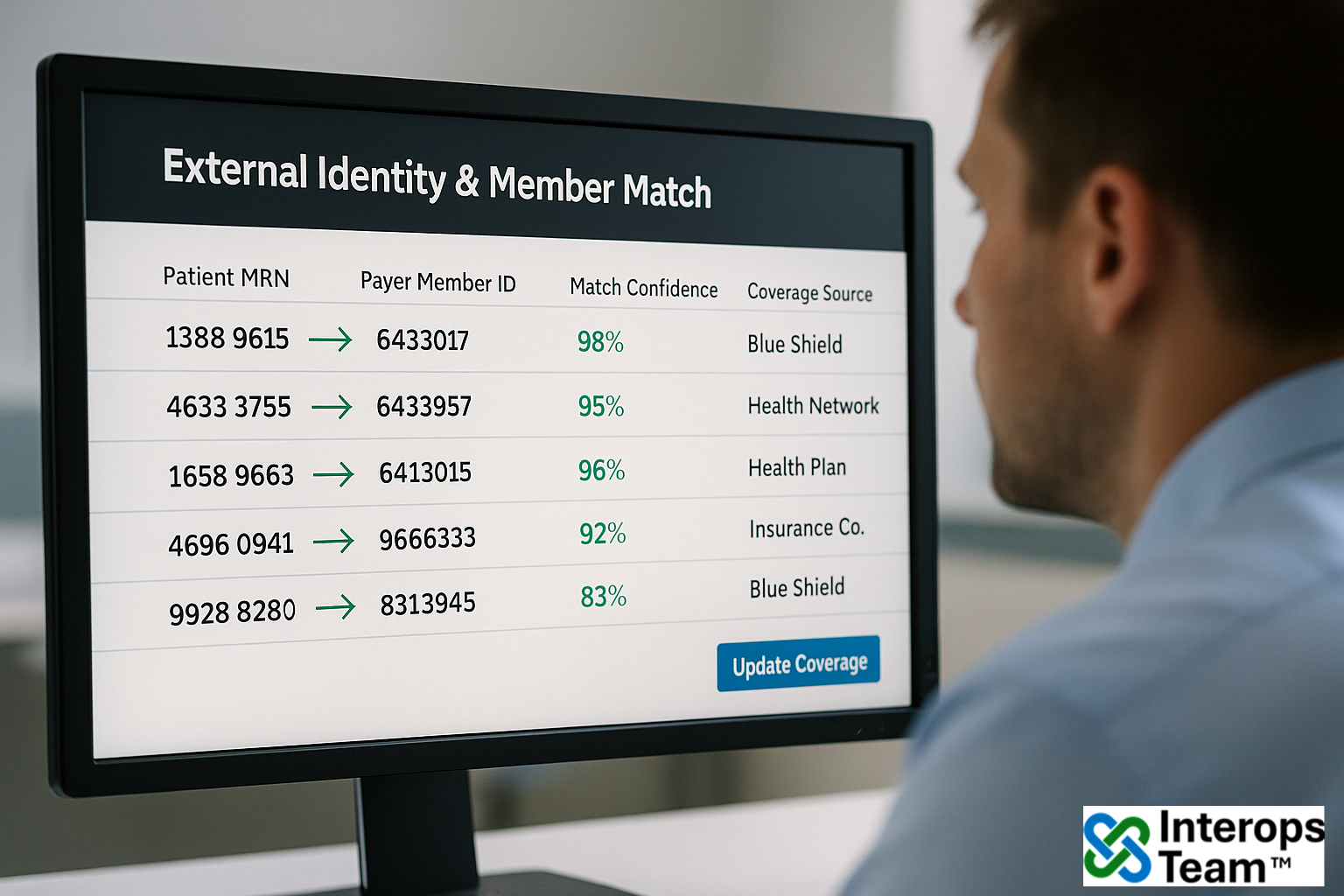
The External Identity & Member Match service bridges provider and payer ecosystems by securely linking patient identities across organizational boundaries. It uses configurable matching logic, deterministic, probabilistic, or hybrid, to connect provider MPIs with payer or network member registries, improving eligibility accuracy and reducing authorization delays.
Operating as a privacy-preserving intermediary, it standardizes demographic and coverage identifiers (e.g., MRN, subscriber ID, plan ID) through FHIR $match and IHE PDQm protocols.
This ensures compliant, traceable identity resolution without sharing unnecessary PHI, strengthening both interoperability and trust between partners.
Benefits
- Improves eligibility precision: Boosts patient/member match accuracy across provider and payer systems.
- Accelerates authorization workflows: Reduces administrative delays by resolving identity discrepancies before pre-authorization checks.
- Strengthens network coordination: Enables consistent patient identification across provider networks, payers, and exchanges.
- Enhances data quality: Prevents redundant records and mislinked claims through governed, standards-based reconciliation.
Capabilities
- Deterministic and probabilistic matching: Uses configurable weights and thresholds for matching based on MRN, subscriber ID, demographics, and plan metadata.
- Privacy-preserving federation: Supports hashed identifiers and minimal PHI exposure during cross-organization exchange.
- FHIR
$matchand PDQm APIs: Implements standardized query and match workflows for scalable interoperability. - Eligibility and coverage retrieval: Links matched identities to real-time coverage data and authorization status.
- Audit and provenance tracking: Maintains full traceability of match attempts, confidence scores, and resolutions.
Great for
- Eligibility and Authorization Teams: Improve match accuracy and reduce delays by connecting provider MPIs to payer member registries.
- Interoperability Architects: Deploy standards-based, privacy-preserving member matching using FHIR
$matchand PDQm protocols. - Population Health and Analytics Leaders: Enable unified reporting and cross-organization analysis through consistent, verified identity resolution.
- Compliance and Data Governance Teams: Maintain defensible, auditable linkage policies while protecting patient privacy and minimizing PHI exchange.
Interops Team implements FHIR
$match, IHE PDQm, and PIX-based identity federation frameworks, supporting secure, HIPAA-aligned member matching between payers, providers, and partner networks.