


Medical terminology permeates the entire health system, appearing in virtually every application and integration. It surfaces as dropdown selections on screens used by practitioners, clinicians, and even patients, covering everything from administrative data such as sex and religion to prescribed medications. In the United States, a handful of core code systems such as LOINC, RxNorm, and the SNOMED CT U.S. Edition, form the foundation. Yet beyond these, there are literally thousands of value sets: some are standalone collections, while others are curated subsets of the major code systems.
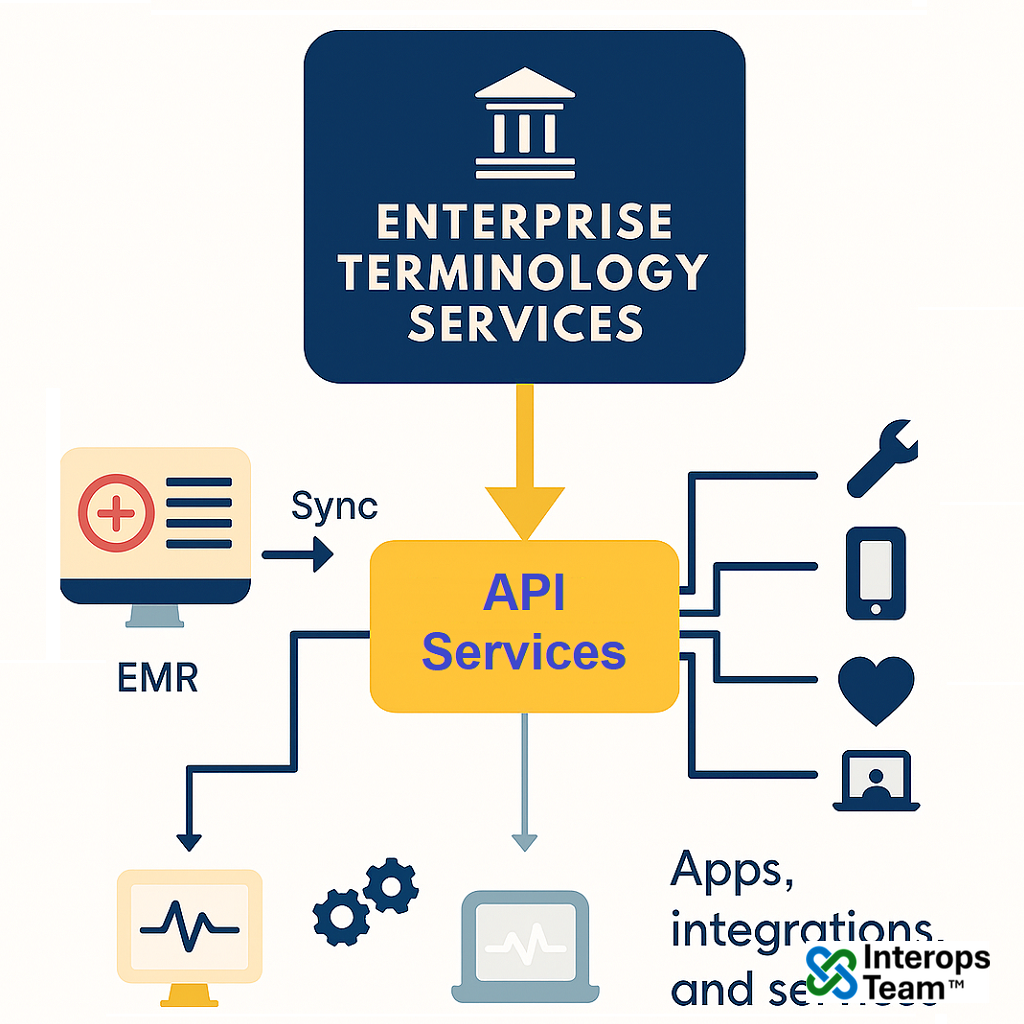
The Enterprise Terminology Services layer gives the organization one place to manage vocabulary and code mapping for all workflows—clinical, payer, analytics, and API-based. Instead of each team maintaining its own spreadsheets and lookup tables, this service exposes a single set of terminology rules through FHIR-based operations.What it provides
- FHIR terminology APIs: Lookup, validate, translate, and expand operations for all major vocabularies.
- Standard code systems: SNOMED CT US Edition, LOINC, RxNorm, UCUM, ICD-10-CM, CPT/HCPCS (where licensed).
- Local code normalization: Map local codes (lab, radiology, procedures, problems) to enterprise standards.
- Value set management: Central management of FHIR ValueSets, including internal and IG-aligned lists.
- Terminology versioning: Track updates so downstream systems always receive the correct version for the date of service.
- Batch and real-time support: Works for high-volume migrations, ELT processes, and real-time APIs.
Why every organization needs this
- Terminology drift is real: Without a shared service, each system uses slightly different codes or versions, causing mismatches.
- US Core and Da Vinci require strict vocabularies: Many validation failures trace back to incorrect or inconsistent coding.
- Analytics teams struggle without normalized data: Population health, quality, and cost analytics all depend on code alignment.
- Digital apps need friendly, reliable labels: Exposing raw SNOMED or LOINC text leads to patient confusion.
Core capabilities
- Code translation: Convert local codes into SNOMED, LOINC, RxNorm, or other target vocabularies.
- Code validation: Confirm that a code is valid for a code system or a value set.
- Value set expansion: Provide complete lists for problem lists, specialties, lab tests, encounter types, etc.
- Concept lookup: Fetch human-friendly display terms, preferred names, and synonyms.
- Terminology governance: Approvals, version control, and audit tracking for changes.
- IG-aligned terminology enforcement: US Core, PDex, PAS, CDex, Plan-Net, ELR, and quality measure vocabularies.
How it integrates
- Upstream: EMRs, HL7v2 feeds, FHIR mapping pipelines, lab and radiology systems.
- Downstream: APIs, digital portals, payer integrations, analytics platforms, FHIR servers.
- Standards: FHIR R4 terminology operations (
$lookup,$expand,$validate-code,$translate).
Why it matters for regulatory work
- CFR 45 Part 170 Subpart B expects accurate, consistent code usage in certified systems.
- CMS quality measures depend on exact value sets—no substitutions allowed.
- Da Vinci IGs often fail validation due to coding issues rather than structural issues.
Great for
- Interoperability teams: Stop re-mapping codes in every interface.
- Analytics and population health: More accurate cohorts and reporting.
- Digital teams: Present clean, patient-friendly terminology in apps.
- Payer integrations: Avoid Da Vinci validation errors tied to coding inconsistencies.