


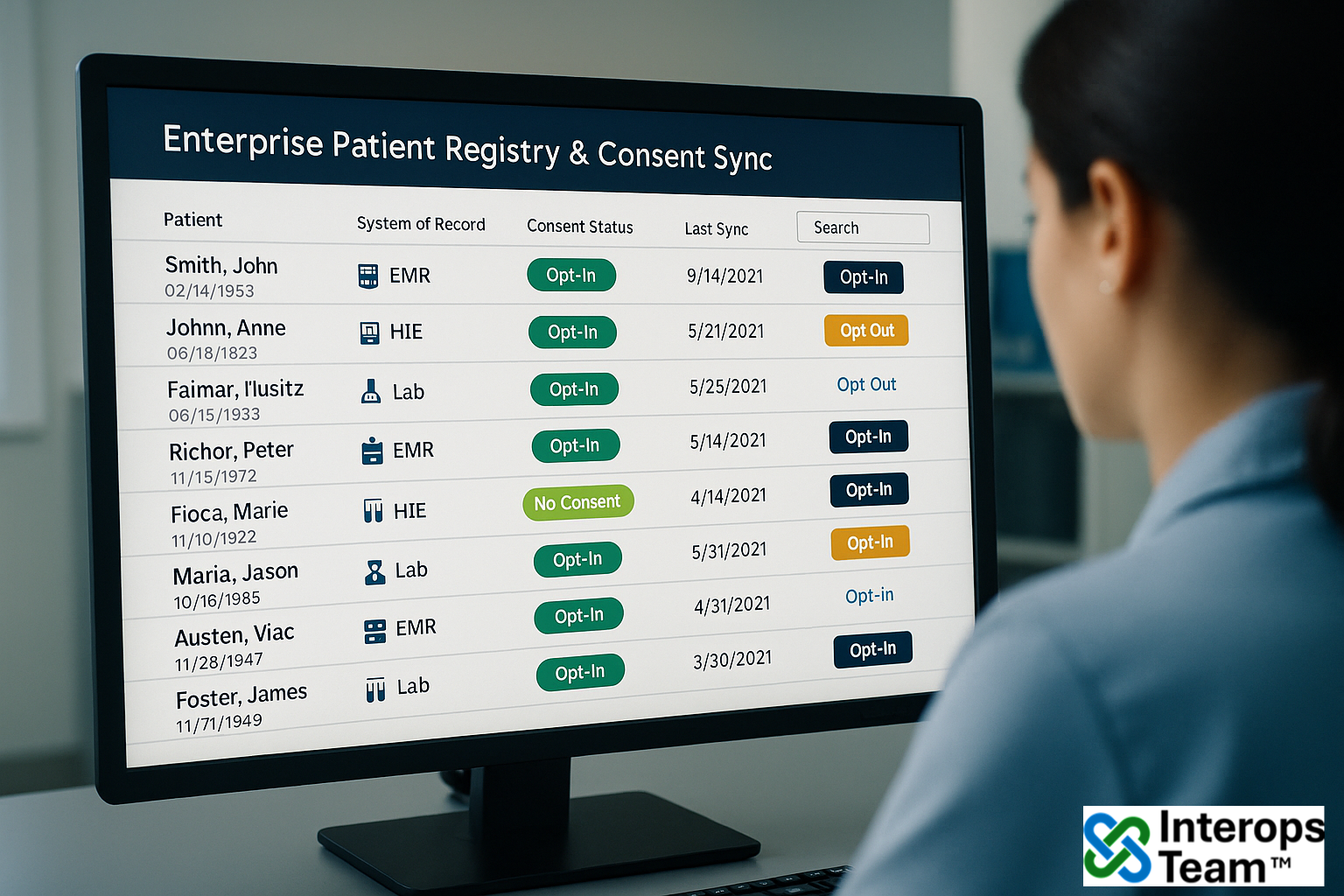
The Enterprise Patient Registry & Consent Sync provides a unified, authoritative view of patient identity and consent status across the enterprise. It maintains system-of-record designations, synchronizes opt-in/opt-out preferences, and propagates updates to downstream systems in real time, ensuring that demographic and privacy data remain consistent and trusted everywhere.
Designed for HIM, privacy, and interoperability teams, this registry acts as the foundation for both identity governance and compliant data sharing. By linking patient identity with HIPAA consent artifacts, it guarantees that every connected application, registry, or exchange honors the latest patient preferences without redundant re-registration or data drift.
Benefits
- Ensures consistent consent enforcement: Keeps HIPAA preferences synchronized and traceable across systems of record and sharing endpoints.
- Improves data accuracy: Reduces demographic mismatches and redundant entries through centralized updates and reconciliation.
- Strengthens trust and transparency: Provides a clear audit trail linking patient consent, identity records, and downstream updates.
- Reduces operational overhead: Eliminates manual re-registration and duplicate data corrections by automating event-driven synchronization.
Capabilities
- System-of-record tagging: Identifies the authoritative source for each demographic field and applies governance rules across linked systems.
- Consent artifact synchronization: Shares and validates HIPAA consent documents (opt-in, opt-out, authorization, proxy) using FHIR
Consentresources. - Event-driven updates: Propagates demographic and consent changes via HL7 v2, FHIR Subscriptions, or messaging queues in near real time.
- Registry reconciliation: Detects and resolves conflicts between local and enterprise-level registries while preserving provenance and timestamps.
- Cross-system audit linkage: Logs every consent or identity update with full provenance to support compliance and regulatory reporting.
Great for
- HIM and Identity Governance Teams: Maintain a single, authoritative registry for patient identity and consent preferences with complete auditability.
- Compliance and Privacy Officers: Ensure enterprise-wide enforcement of HIPAA opt-ins/opt-outs through traceable, synchronized consent artifacts.
- Integration and Interoperability Architects: Implement event-driven synchronization of registries using HL7 v2, FHIR, and IHE XDS/XCA frameworks.
- Enterprise Data Stewards: Reduce duplication, ensure demographic consistency, and align identity governance across clinical and administrative systems.