


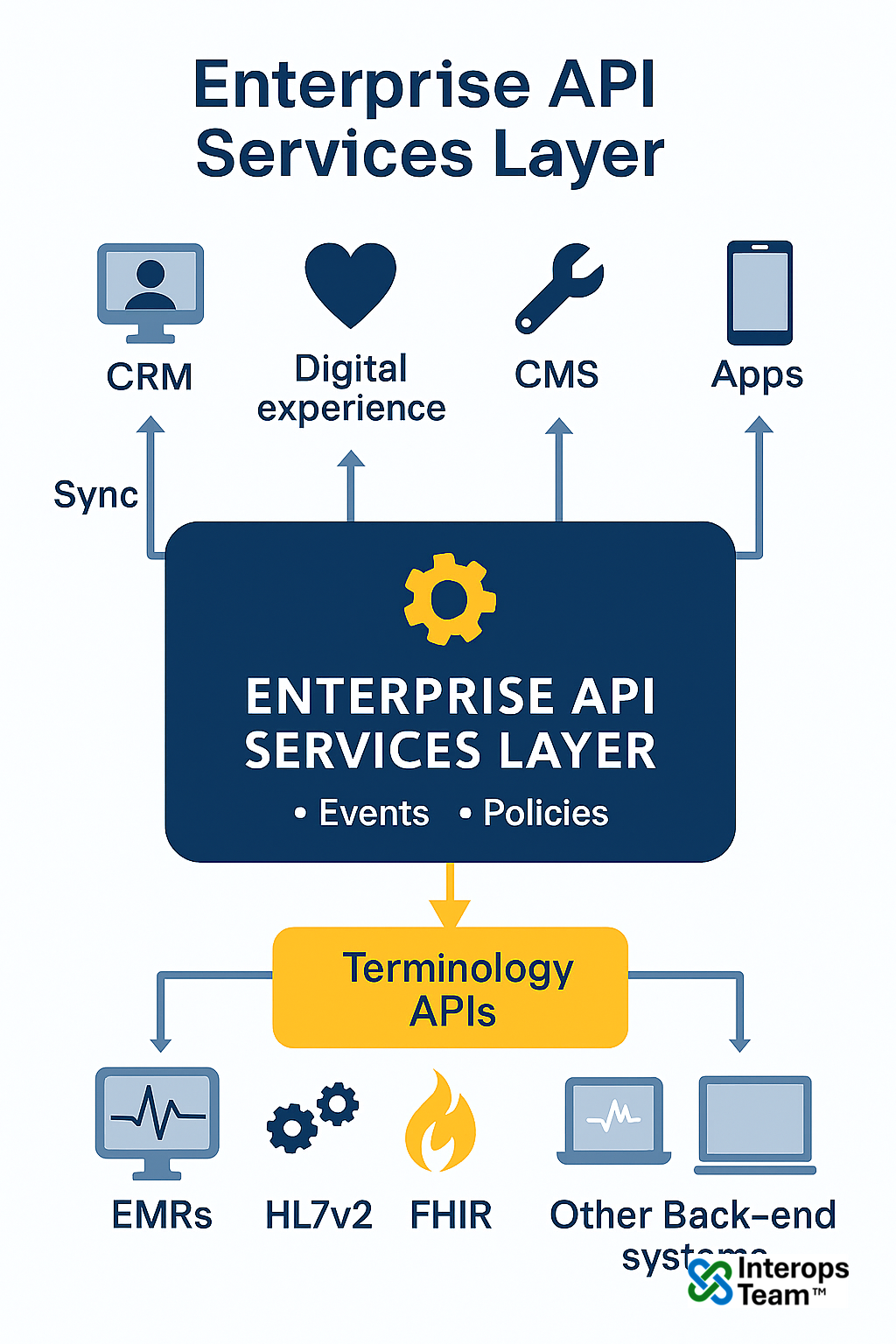
The Enterprise API Services Layer for Interoperability is the “front door” for clinical and operational data. Instead of wiring every CMS, CRM, and digital platform directly to EMRs and back-end systems, it offers a consistent set of APIs, events, and policies that sit between core systems and everything that wants to talk to them.
Problem it addresses
Many organizations let integrations grow one connection at a time, especially around CMS mandates, digital front doors, and CRM rollouts. The result is tight coupling, inconsistent rules, and expensive rework whenever an EMR, payer connection, or platform changes. A services layer breaks that pattern by separating what external consumers need from how back-end systems store and exchange data.
Core Capabilities
- API gateway front door: OAuth2/OIDC, routing, rate controls, and basic transformations for FHIR, REST, and event traffic.
- Service abstractions: Stable APIs for common needs such as “patient summary,” “provider directory,” “encounter feed,” or “care gaps,” independent of any one EMR or data source.
- Event and message orchestration: Connects HL7 v2 feeds, FHIR subscriptions, and other events into reusable patterns for downstream apps, analytics, and CMS workflows.
- Policy and consent hooks: Invokes HIPAA Minimum Necessary, consent, and break-the-glass checks before data leaves trusted core systems.
- Implementation flexibility: Can be implemented with a modern API gateway, an ESB, a healthcare integration engine, or a mix, as long as it exposes clean, documented contracts.
How it supports CMS, CRM, and digital platforms
- CMS and payer APIs: Routes traffic for patient access, provider directory, and prior authorization workflows without letting external rules bleed into EMR interfaces.
- Digital experience platforms (Sitecore, Adobe, etc.): Consume curated APIs for “find care,” appointments, and content personalization instead of bespoke one-offs per channel.
- CRMs (Salesforce, Dynamics, etc.): Get reliable, governed views of patients, referrals, and outreach targets from the same API layer used by other consumers.
Integration & Architecture Alignment
- Aligns with an anti–point-to-point integration strategy, favoring reusable services and events.
- Supports FHIR R4, HL7 v2, and batch/bulk patterns where needed, with clear boundaries between transport and business logic.
- Compatible with healthcare integration engines (Rhapsody, Cloverleaf, Mirth, etc.) and general-purpose ESBs or API gateways.
Great for
- Enterprise and Integration Architects: Define a durable interoperability backbone that can survive EMR upgrades, platform changes, and new mandates without wholesale rewiring.
- Digital and CRM Teams: Build against stable APIs instead of chasing every interface detail of EMRs and legacy systems.
- Security, Privacy, and Compliance: Centralize access, logging, and policy enforcement at the service layer rather than sprinkling rules across dozens of custom integrations.