


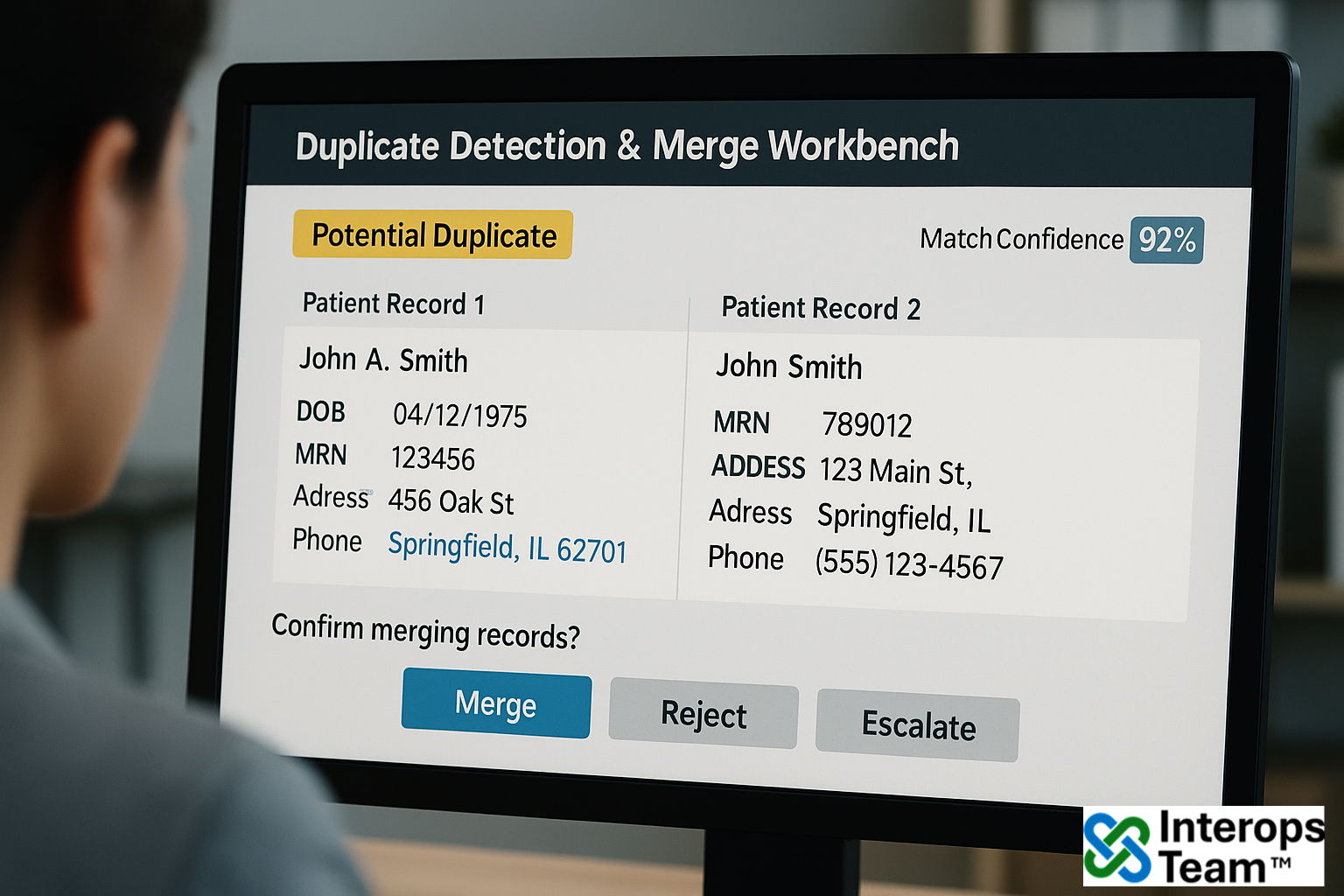
The Duplicate Detection & Merge Workbench provides a governed, auditable workspace for resolving suspected duplicate and overlaid patient records. It integrates real-time scoring algorithms with human review to help HIM and data governance teams identify, validate, and safely merge or unlink patient identities across enterprise systems.
By combining automated candidate generation with structured, side-by-side comparison, the workbench makes survivorship decisions transparent and defensible. Each merge is fully audited with rollback options and metadata traceability to meet both operational and compliance standards.
Benefits
- Improves data integrity: Systematically identifies and resolves duplicates to maintain a trusted enterprise master index.
- Reduces operational risk: Prevents clinical and billing errors caused by record overlays and inconsistent identifiers.
- Enforces governance: Embeds role-based permissions and approval checkpoints for safe, compliant merge actions.
- Provides audit transparency: Generates complete merge history with timestamps, operators, and attribute-level changes.
Capabilities
- Real-time duplicate scoring: Continuously queues potential matches using configurable probabilistic and deterministic rules.
- Side-by-side comparison: Displays attribute-level differences and confidence scores to support informed decision-making.
- Survivorship control: Allows field-level selection of surviving values with downstream impact previews.
- Rollback and audit traceability: Supports undo operations with ATNA-style audit exports and provenance metadata.
- Threshold governance: Escalates borderline matches for human review, ensuring defensible resolution workflows.
Great for
- HIM and Identity Governance Teams: Resolve suspected duplicates and overlays with governed, auditable workflows and survivorship previews.
- EMPI Stewards and Data Quality Analysts: Maintain a clean, trusted master index through transparent scoring, side-by-side review, and rollback controls.
- Compliance and Risk Officers: Mitigate clinical and billing risk by enforcing policy-aligned merge procedures and complete audit exports.
- Integration and Data Architects: Align merge logic with PIX/PDQ/PDQm interoperability standards and enterprise data governance frameworks.
Interops Team implements Connectathon-tested PIX and PDQm interoperability frameworks, supporting governed, standards-based identity reconciliation and merge workflows across HL7 v2, HL7 v3, and FHIR systems.