


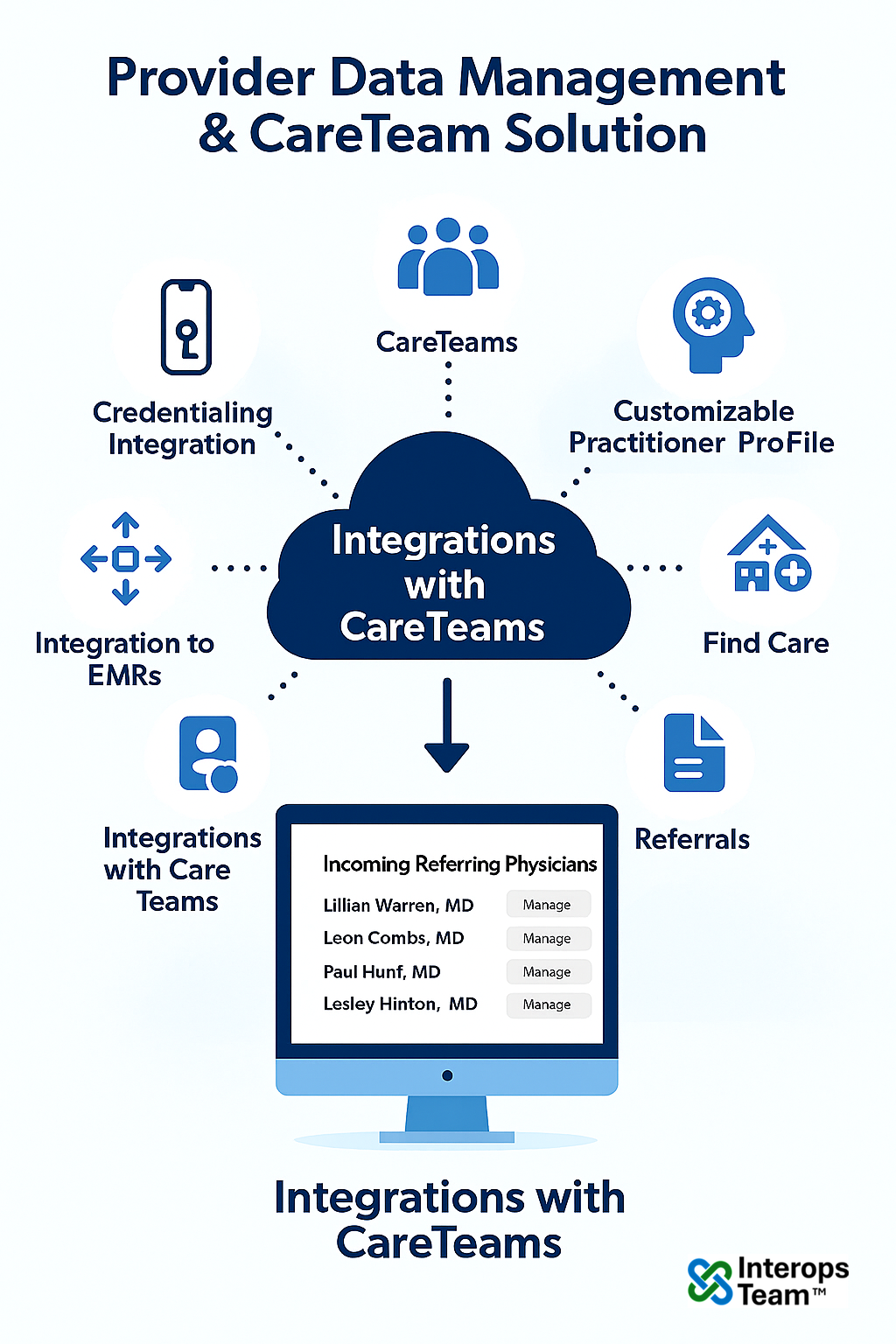
The Care Team Service is a relationship layer that sits on top of the Provider Data Management (PDM) directory.
PDM holds the facts about people, locations, and services. The Care Team Service uses FHIR CareTeam to store the relationships between patients and team members, always pointing back to the same practitioners and roles in PDM.
Two-layer model
- PDM (mCSD Directory Hub): Practitioner, PractitionerRole, Organization, Location, HealthcareService, and extended profile fields for digital front door use cases.
- Care Team Service: FHIR
CareTeamresources that connect patients to team members by reference, using PDM as the directory of people and services.
How the data is structured
- PDM directory: Each clinician or caregiver is represented as a
Practitionerand one or morePractitionerRoleentries tied to organizations, locations, and services. - CareTeam resources: Each
CareTeamrecord links aPatientto one or more participants, where each participantmemberpoints to aPractitionerRole,Organization, orHealthcareServicein PDM. - Non-licensed caregivers: Community workers, navigators, and other non-credentialed roles are still modeled as
PractitionerandPractitionerRole, but with empty or minimal credentialing fields.
Query pattern
The service keeps the navigation simple and consistent:
- Query Patient.
- Find one or more CareTeam resources where
subject = Patient. - For each care team participant, follow the
memberreference toPractitionerRole,Practitioner,Organization, orHealthcareServicein PDM.
This lets any app quickly answer: “Who is on this patient’s team?” and “What do we know about these team members?” using the same directory that powers referrals and the digital front door.
Digital front door alignment
The Care Team Service does not store marketing or preference fields itself. Those live in PDM, where digital teams maintain:
- Physician and caregiver biographies, interests, and specialties.
- Languages, telehealth availability, and accessibility details.
- New-patient status, insurance participation, and panel rules.
- Profile photos and display names.
When a digital or care coordination app needs to show care team members, it reads CareTeam for relationships and PDM for the rich profile.
Use cases
- Care coordination apps: Display the current care team for a patient, including PCP, specialists, care managers, social workers, and community partners.
- Referral workflows: Attach or update the care team when referrals are sent, so downstream teams know who is already involved.
- Digital front door: Let patients see “My care team” in the portal or mobile app, with profile details coming from PDM.
- Analytics and quality: Analyze outcomes and workloads by care team composition, role, and program participation.
Integration & standards
- Directory backbone: FHIR R4 Practitioner, PractitionerRole, Organization, Location, HealthcareService (aligned with IHE mCSD).
- Relationships: FHIR R4 CareTeam linking patients to directory entries.
- Sources of truth: PDM owns provider and caregiver identity and profile data; Care Team Service owns relationship history.
Great for
- Care management and coordination teams: Manage patient-specific teams without duplicating provider data.
- Digital experience teams: Present a clear “My care team” view that stays in sync with real operations.
- Interoperability and architecture teams: Keep directory and relationship logic cleanly separated but tightly linked.