


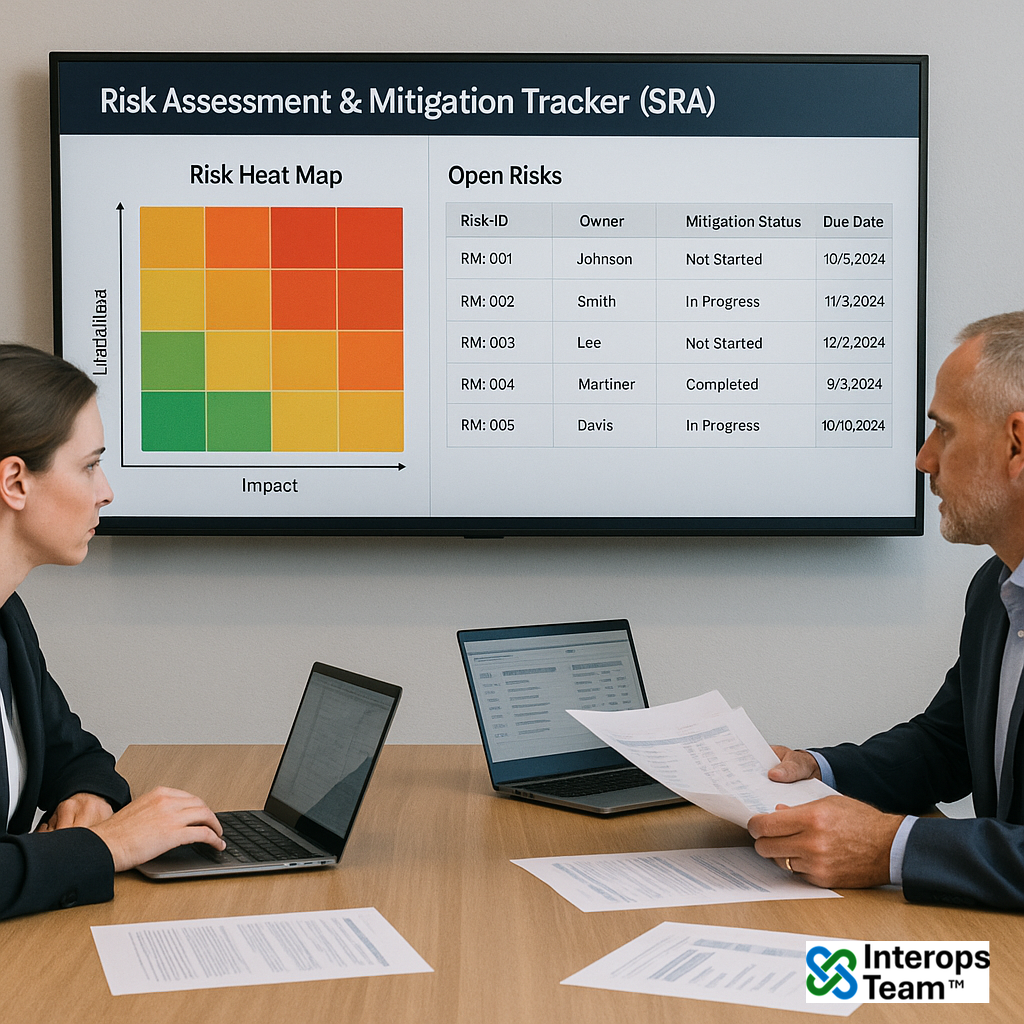
Goal: Turn the annual HIPAA Security Risk Analysis (45 CFR 164.308(a)(1)(ii)(A)) into a continuous, evidence-backed program with transparent remediation tracking and leadership visibility.
Assessment Framework
- Library of NIST 800-53 / HICP 405(d) safeguards mapped to HIPAA Security Rule controls.
- Control-by-control questionnaires with evidence attachments (configs, screenshots, test logs).
- Automated feeds from scanners and logs to pre-populate findings where possible.
- Risk scoring model: likelihood × impact with configurable scales and residual risk.
Mitigation & Oversight
- Action plans with owners, budgets, dependencies, and due dates.
- Workflow states: Open → In Progress → Pending Verification → Closed.
- Verification evidence required for closure; residual risk documented if accepted.
- Feeds exceptions to Policy & Procedure Library and training updates when applicable.
Dashboards & Reporting
- Risk heat map (red/yellow/green) by domain (Access Control, Audit, Transmission Security, etc.).
- Top risks, aging items, and bottlenecks by owner or department.
- Executive summaries; OCR-ready export with evidence index and timestamps.
Governance & Evidence
- Change history for each control and finding; versioned artifacts.
- Attestations from control owners and sign-offs from Security/Privacy leadership.
- Traceability from risk → mitigation → verification → residual risk acceptance.
Integration
- Ticketing (Jira/ServiceNow) for tasks and escalations.
- Scanner inputs (vuln, config, EDR) for automated evidence intake.
- Links to Audit Event Hub, Breach Tracker, and Training Tracker for systemic fixes.
Value
- Compliance: Defensible SRA with live evidence and audit-ready exports.
- Security: Clear ownership and measurable risk reduction.
- Executives: Visibility into risk posture and time-to-remediate.