


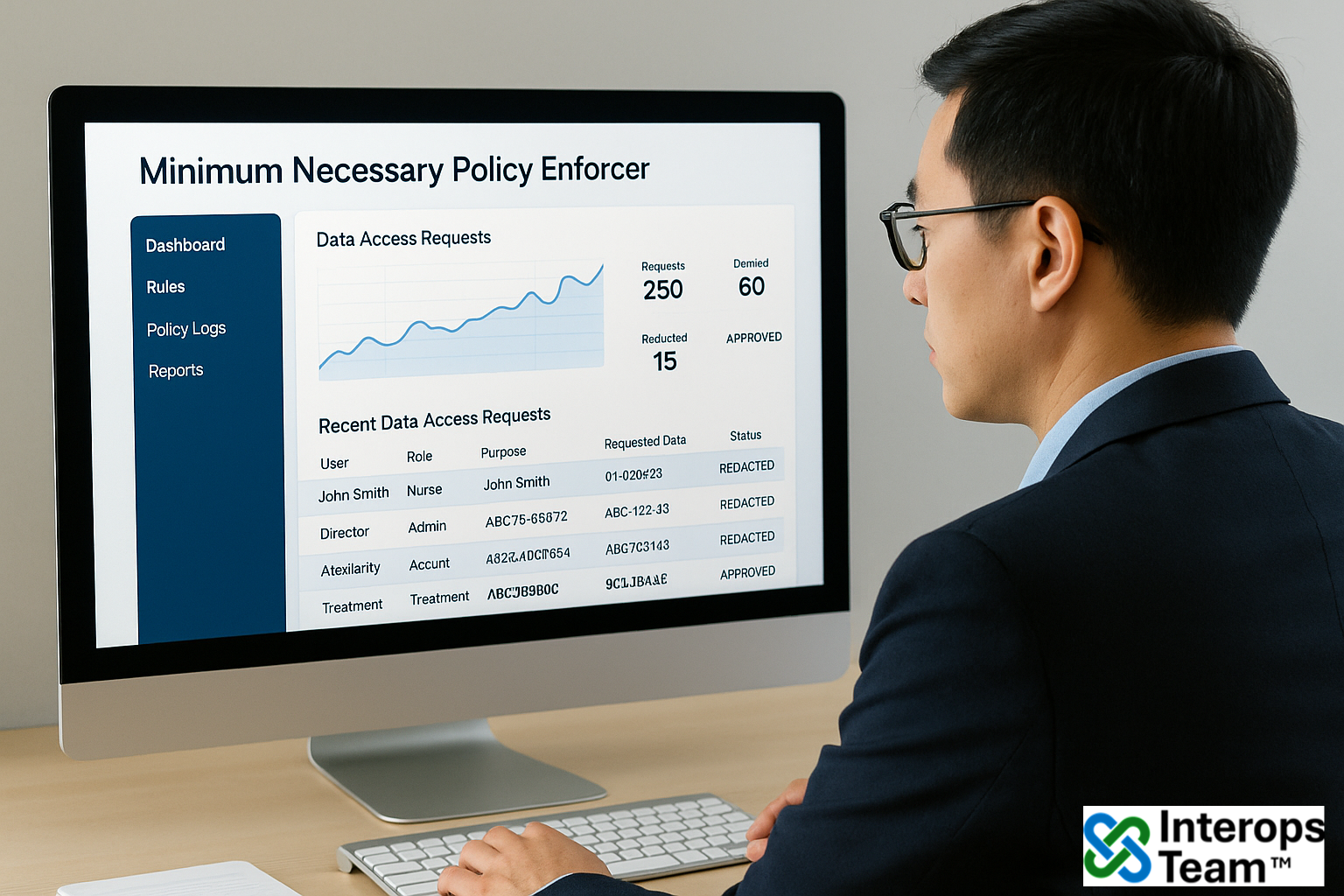
Purpose: Implement the HIPAA Minimum Necessary standard programmatically across data requests, ensuring that only the least amount of PHI required for a valid purpose is disclosed or returned. Applies dynamic rules based on user role, system, purpose-of-use, and request context.
How It Works
- Policy Evaluation Engine: Maps each requestor (person or system) to a defined purpose-of-use, Treatment, Payment, Operations, Research, or Other, and evaluates against whitelists for allowed data elements.
- Rule Enforcement: Removes or masks unauthorized fields (e.g., identifiers, notes, or entire resources) from queries, reports, and APIs before data leaves the system.
- Context Awareness: Considers both static access rules and dynamic context, such as patient assignment, encounter location, or emergency override status.
- Overrides: Supports just-in-time justification and time-boxed exceptions, logged with reason and authorizer identity.
Compliance & Evidence
- Logs every enforcement action, including removed fields, justification for override, and resulting data footprint.
- Generates compliance summaries showing reduction rates of PHI exposure per data stream.
- Integrates with Audit Event Hub and Access Review Console for end-to-end traceability.
- Provides ready-to-submit OCR audit packets with policy, logs, and impact analysis.
Capabilities
- Row/column suppression, redaction, and tokenization of PHI values.
- Rules for structured (FHIR/HL7) and unstructured (PDF, XML, CSV) data flows.
- Purpose-specific filters for exports, analytics, APIs, and system integrations.
- Policy authoring interface with version control and simulation testing.
Governance
- Rule library mapped to HIPAA §164.502(b) and §164.514(d).
- Attestation workflow for policy approval and periodic review.
- Integration with Identity & Access Management for automatic scope sync.
Value
- Compliance: Enforces Minimum Necessary disclosures without relying solely on manual review.
- Security: Prevents over-disclosure of PHI across data interfaces and exports.
- Operations: Enables real-time compliance without slowing down integrations or analytics.