


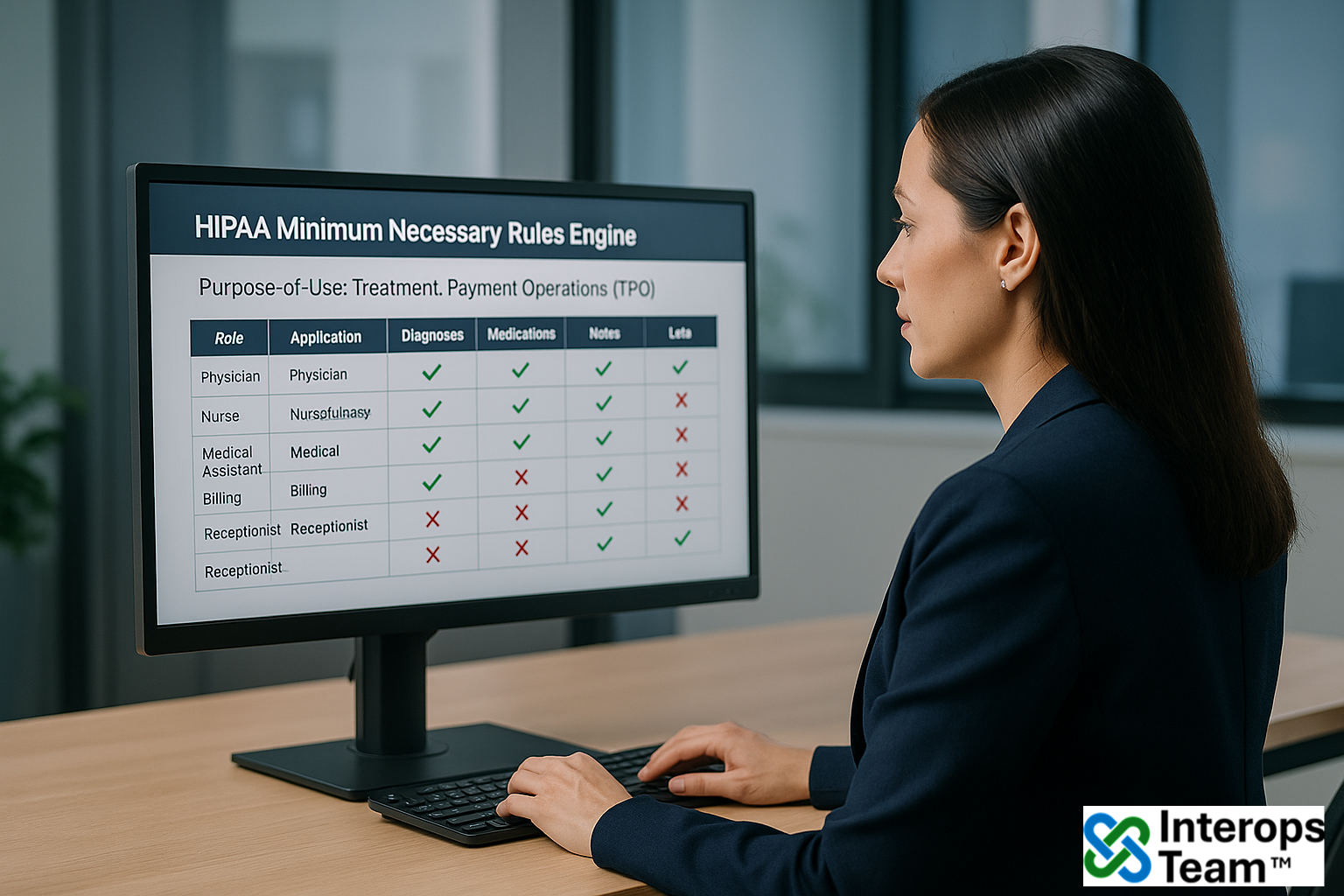
Purpose: Enforce the HIPAA Minimum Necessary requirement programmatically across all data access workflows, searches, reports, analytics queries, and exports. The Rules Engine evaluates who is requesting data, why they are requesting it, and what data elements are appropriate to disclose, dynamically adjusting results to ensure compliance.
Policy Model
- Role + Context + Purpose = Scope: Each request is evaluated against the user’s role, current assignment (e.g., care team, department), and declared purpose-of-use (Treatment, Payment, Operations, etc.).
- Gateways & Enforcement Points: SQL guardrails, FHIR interceptors, and API gateways apply row/column filters, field-level redactions, and cohort-based access limits.
- Overrides: Users can elevate access temporarily through just-in-time approval, with justification captured and time-boxed auto-revocation.
Compliance & Evidence
- Decision logs capture requester identity, policy version, justification, and differences between requested vs. returned data.
- Audit exports show rule application history for OCR or internal reviews.
- Attestation workflows for high-risk roles or recurring override patterns.
Administration & Testing
- Admin console for creating, testing, and deploying Minimum Necessary policies.
- A/B simulation mode allows validation against historical queries before enforcement.
- Version control and rollback for policy changes with full approval chain.
Dashboards & Reporting
- Exception trends by department, data type, and purpose-of-use.
- Metrics for PHI reduction and policy enforcement effectiveness.
- Visualization of requests trimmed, denied, or redacted per rule set.
Value
- Compliance: Enforces Minimum Necessary at the system level with defensible evidence.
- Security: Prevents over-disclosure of PHI and reduces data leakage risk.
- Operations: Enables controlled sharing without hindering legitimate workflows.