


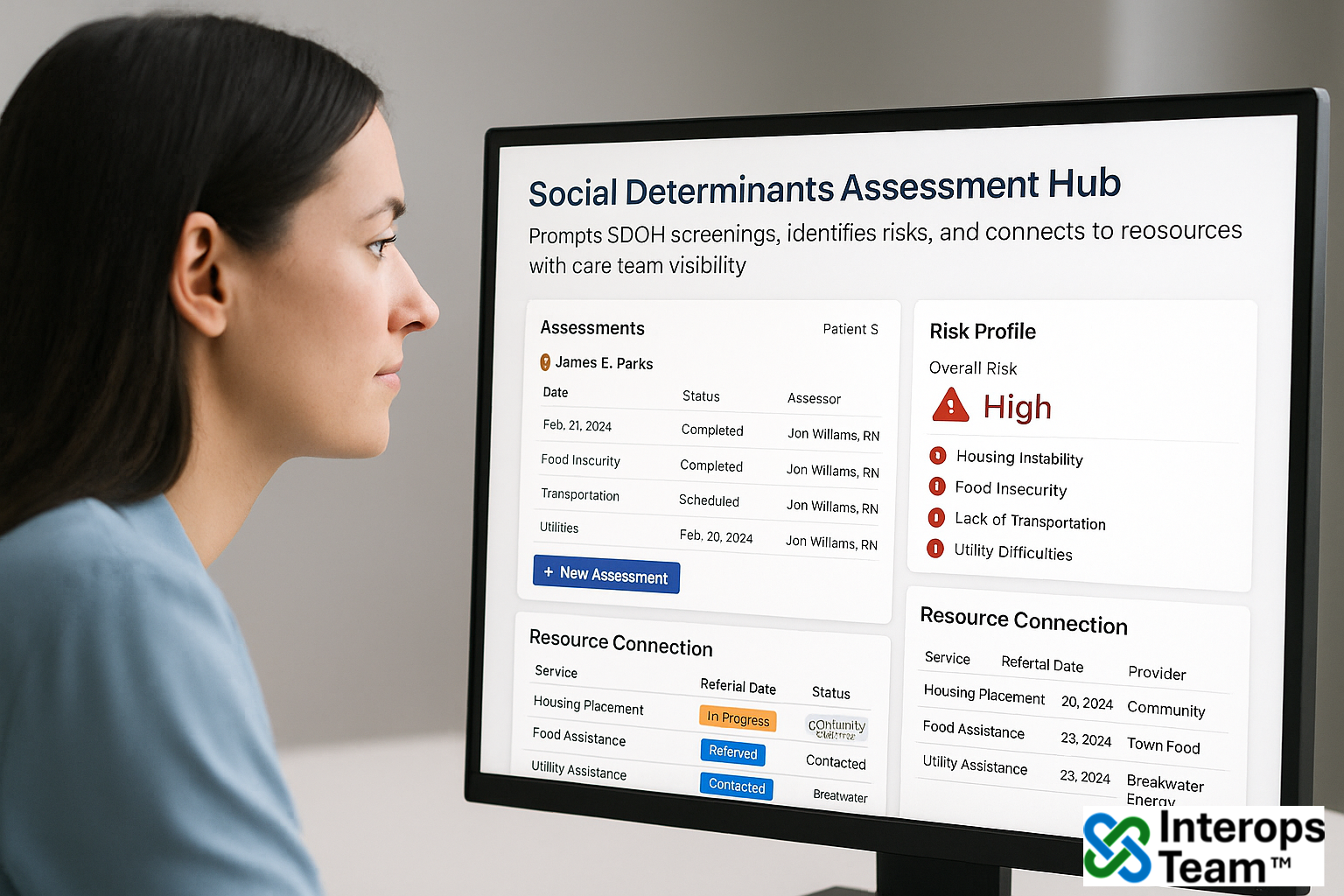
The Social Determinants Assessment Hub unifies how health systems identify and address non-clinical needs, housing, food, transportation, safety, employment, and more. It serves as a centralized workspace for capturing SDOH screenings, generating structured referrals, and maintaining visibility across community follow-up loops.
By leveraging FHIR Questionnaire, Observation, and Task resources, the hub standardizes data capture and automates next steps. Screening results can trigger outbound referrals to community organizations, notify care coordinators, and update patient records with standardized Z-codes and social risk factors. Feedback from community partners flows back into the EMR, closing the loop between healthcare and social care.
Benefits
- Improved health equity tracking: Standardized data supports population-level insights and regulatory reporting.
- Reduced unmet social needs: Converts screening results into timely referrals and actionable interventions.
- Stronger community partnerships: Builds a two-way exchange between providers, payers, and social service agencies.
- Better patient engagement: Integrates SDOH into the care plan so patients feel seen and supported beyond the clinical encounter.
Key Capabilities
- FHIR Questionnaire + Observation capture for structured SDOH screening (e.g., PRAPARE, AHC).
- Automated referral routing and feedback workflows to community partners.
- Directory of verified community resources with contact, eligibility, and service metadata.
- Z-code generation and reporting for equity and reimbursement initiatives.
- Outcome dashboards with closed-loop completion tracking and intervention metrics.
Great for
- Care Coordinators and Social Work Teams: Identify and respond to social risks through structured screening, automated referrals, and real-time feedback tracking.
- Equity, Population Health, and Quality Leaders: Improve visibility into social factors impacting outcomes and report on community engagement and Z-code utilization.
- Clinical Informatics and EMR Analysts: Govern screening logic, referral standards, and data exchange with community platforms using FHIR-based integration.
- Community-Based Partners: Receive structured referrals, update status electronically, and build consistent feedback loops back into the care continuum.