


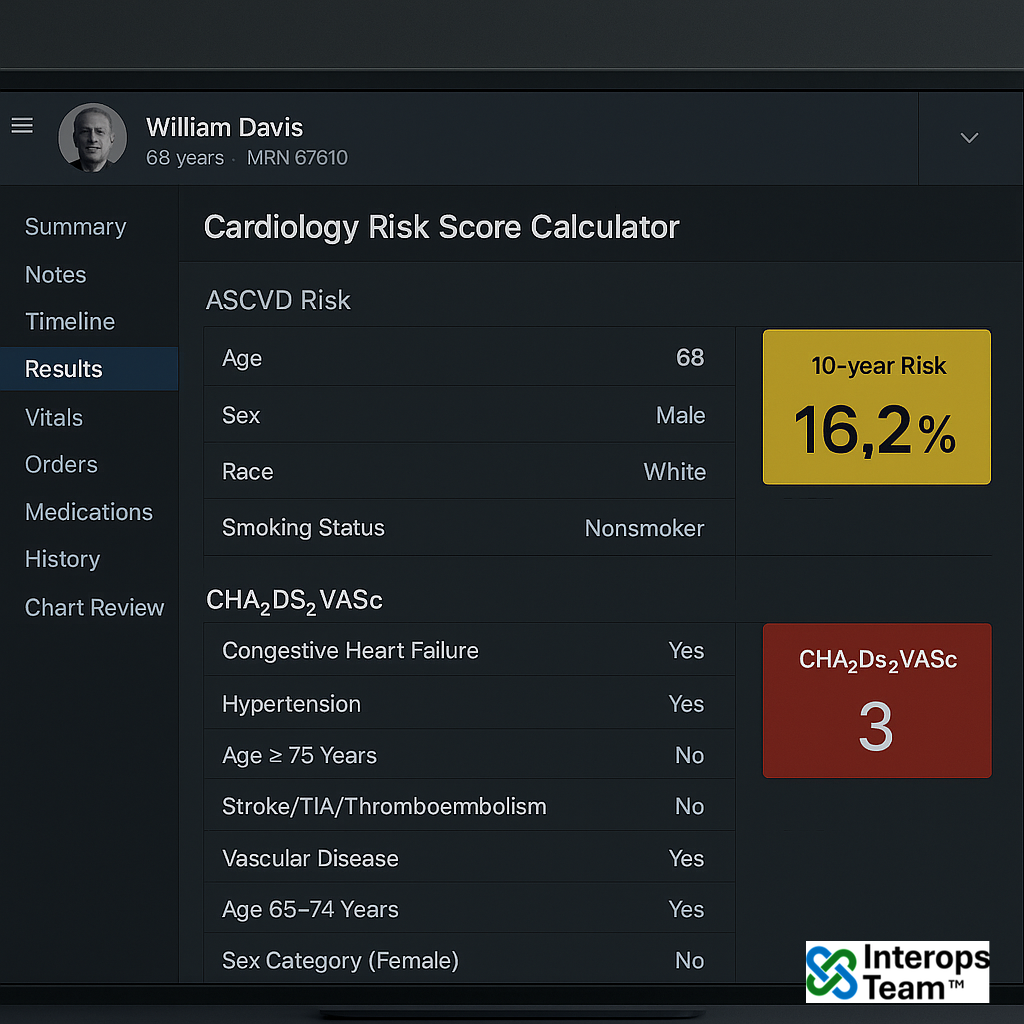
The Cardiac Risk & Medication Reconciliation Hub consolidates cardiac risk indicators, medication lists, and evidence-based care prompts into one interactive panel inside the EMR. It identifies gaps such as missing statins or beta blockers, flags risk factors like smoking or uncontrolled hypertension, and provides one-click order sets and note templates to close care gaps directly from the chart.
This tool bridges clinical decision support and medication reconciliation, helping providers align treatment with ACC/AHA guidelines while maintaining accurate, auditable medication records. It supports contextual prompts during encounters, empowering clinicians to reconcile, prescribe, and document within a single, efficient workflow.
Benefits
- Improves guideline adherence: Surfaces evidence-based recommendations in context, such as statin eligibility or antiplatelet therapy prompts.
- Enhances medication safety: Detects duplications, omissions, and contraindications while maintaining accurate med histories.
- Streamlines workflow: Combines reconciliation, risk review, and order entry into a unified SMART-on-FHIR interface.
- Supports quality reporting: Captures structured interventions for registry, value-based care, and MIPS reporting.
Capabilities
- SMART-on-FHIR embedded panel: Launches directly within the EMR to access live patient data and write-back results.
- Automated risk assessment: Calculates ASCVD and other risk scores from vitals, labs, and problem lists.
- Gap detection engine: Flags missing therapies (e.g., statins, ACE inhibitors) and unresolved risk factors (e.g., smoking, hypertension).
- One-click order and documentation templates: Streamlines prescribing, patient education, and note generation for compliance.
- FHIR integration: Reads and updates
MedicationStatement,MedicationRequest, andObservationresources in real time.
Great for
- Cardiologists and Primary Care Providers: Review cardiac risk, reconcile medications, and close gaps with one-click guideline-based interventions.
- Medication Safety and Quality Teams: Ensure accurate reconciliation and promote evidence-based prescribing with auditable CDS support.
- Clinical Informatics and EMR Analysts: Govern CDS logic, maintain FHIR-based mappings, and monitor adherence metrics across populations.
- Population Health and Value-Based Care Leads: Track adherence trends and feed structured outcomes into quality improvement dashboards.
MedicationRequest, Observation, and Condition resources, embedding evidence-based prompts aligned with ACC/AHA cardiac care guidelines.