


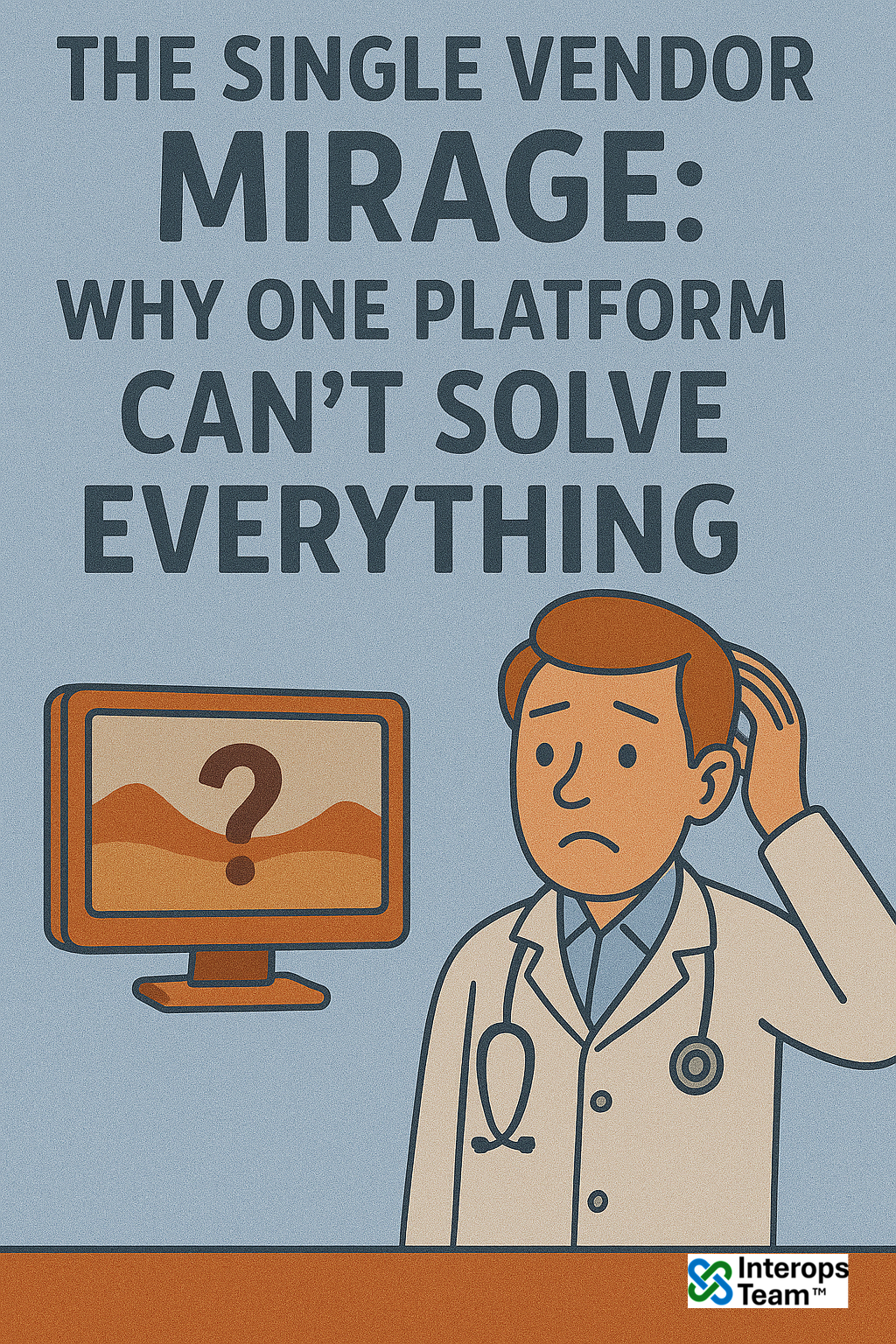
Many healthcare organizations pursue a “single vendor” strategy, hoping that one dominant platform will simplify integration, reduce contracting overhead, and align stakeholders around a unified roadmap. On paper, this approach promises coherence and predictability. In practice, it often creates blind spots, limits flexibility, and concentrates risk in ways that only become visible when the organization tries to innovate beyond the vendor’s core strengths.
Relying on a single vendor for clinical, financial, and interoperability needs can lead to architectural monoculture. While this may simplify some aspects of support, it also means that shortcomings or delays in the vendor’s roadmap ripple across the entire enterprise. When regulatory deadlines or market shifts demand capabilities that the vendor is slow to deliver, the organization finds itself constrained by decisions made years earlier.
The single vendor model can also suppress healthy experimentation. Teams may be discouraged from exploring specialized tools or best-of-breed solutions that address specific problems more effectively than generic platform features. Concerns about support, contracting, or integration with the primary vendor are sometimes used to shut down options before their value is fully understood.
Moreover, the idea that a single vendor strategy simplifies interoperability is often overstated. Even in heavily standardized environments, health systems must connect to external partners, payers, HIEs, and third-party apps that live outside the primary platform. The need for robust integration capabilities, governance, and standards expertise does not disappear simply because internal systems share a common vendor.
A more resilient approach treats strategic vendors as anchors rather than monopolies. Their platforms provide essential capabilities, but the architecture anticipates and accommodates additional tools where they add clear value. Integration is designed as a first-class discipline, not as an afterthought. In that model, the organization benefits from the stability of strong vendor relationships without giving up the flexibility to evolve alongside rapidly changing clinical and regulatory demands.
Designing on purpose for multi-vendor reality
Interops Team™ helps you plug best-of-breed systems into a coherent whole instead of chasing a mythical single platform. We design architectures that respect EMR gravity while leaving room for innovation.
- Map vendor capabilities to clinical and business needs
- Define an integration and data strategy that spans platforms
- Establish rules of engagement so new vendors can plug in cleanly