


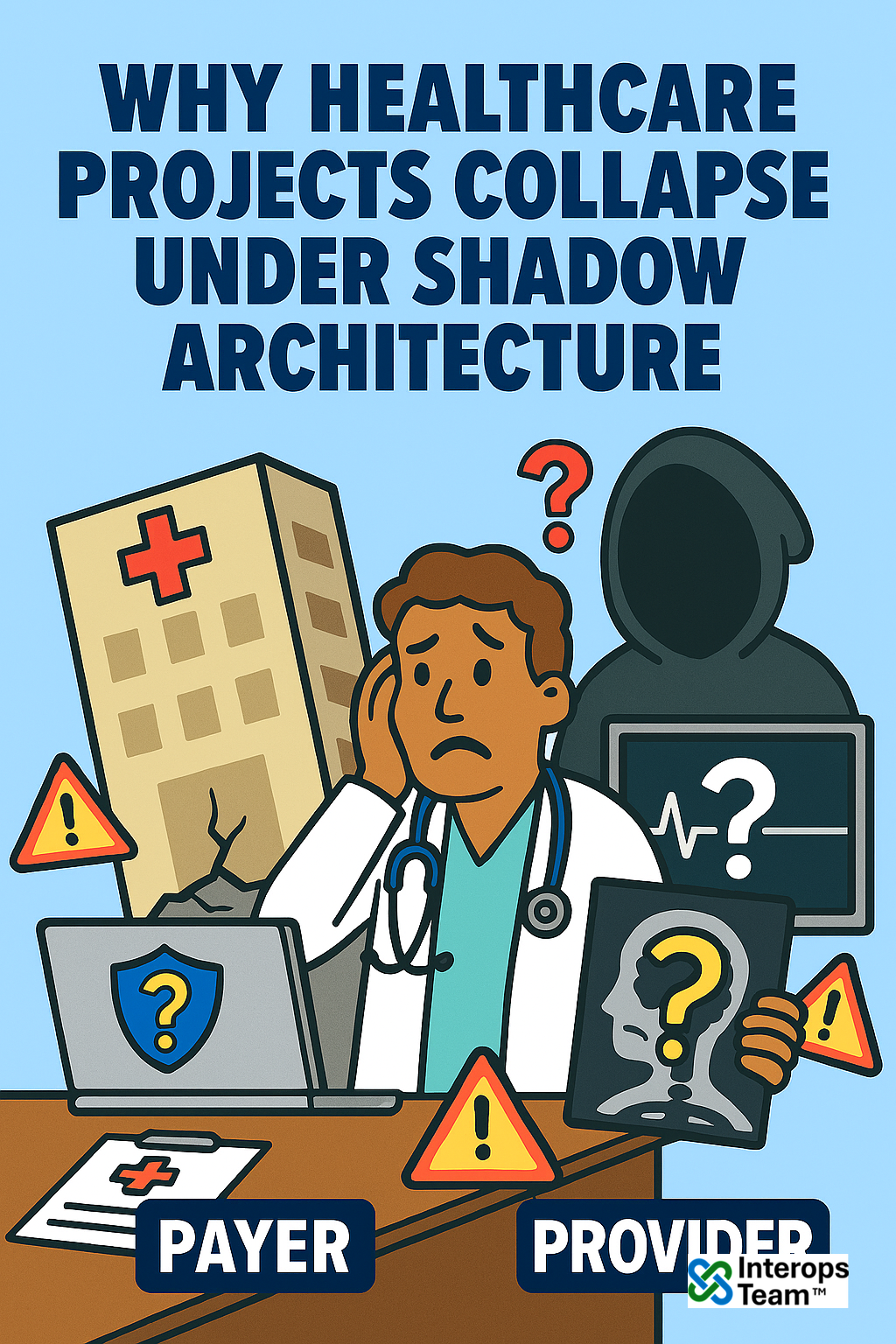
In many healthcare organizations, architecture diagrams and governance documents paint a picture of order, alignment, and disciplined decision-making. Yet real projects often drift into instability because of decisions made outside those structures, a phenomenon that can be called shadow architecture. These are design choices introduced by individual teams, vendors, or stakeholders without enterprise review and without understanding how they impact clinical workflows, security boundaries, or regulatory requirements. Shadow architecture accumulates silently until it becomes the system's true architecture, at which point the formal diagrams no longer reflect reality.
This phenomenon emerges for predictable reasons. Business teams move quickly and bypass technical review to meet deadlines. Vendors push their preferred patterns rather than aligning with the organization's standards (very common with consulting vendors). Product teams focus on UI and UX decisions without clinical or technical context. Integration teams create shortcuts to get data flowing, unaware they are creating brittle dependencies. None of these actions are malicious; they are symptoms of organizations that lack clear processes, unified technical leadership, or sufficient healthcare-specific expertise to evaluate decisions upstream.
The impact is significant. Shadow architecture introduces inconsistencies in authentication, data models, API contracts, and transformation layers. It disrupts normalization strategies, complicates test automation, and makes data lineage difficult to trace. Most importantly, it jeopardizes clinical safety when inconsistent patterns result in lost metadata, broken data provenance, or incorrect translations. By the time leadership recognizes the problem, the system is held together by patches and interpretations rather than principles.
The solution requires more than stricter governance. Organizations must elevate architectural authority, centralize standards, and embed regulatory and clinical expertise into every decision point. Transparency and shared ownership eliminate the need for shortcuts, while property-driven design reduces ambiguity. When architectural truth and architectural documentation finally align, projects stabilize and trust in the system is restored.
Surfacing and taming shadow architecture
Interops Team™ helps you find the hidden integrations, scripts, and databases that quietly run your hospital. We bring them into the light so future projects plug into a stable, intentional architecture.
- Discover undocumented feeds, integrations, queries, and that projects silently depend on
- Classify what belongs in the trusted core versus local convenience tooling
- Refactor high-risk components into supported, monitored integration patterns