


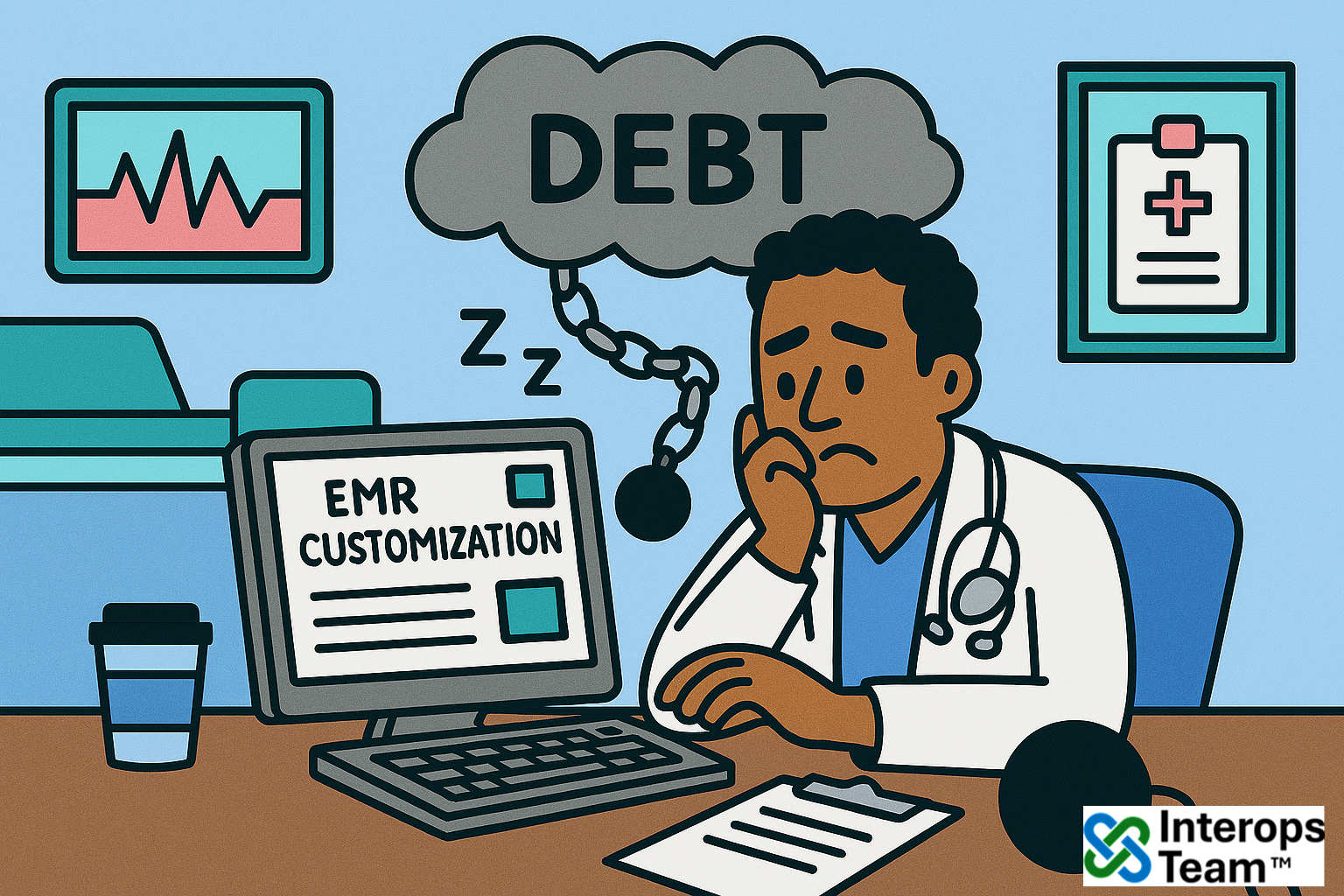
Electronic medical records were designed to be configurable and extensible, allowing organizations to adapt workflows, order sets, and documentation templates to local needs. Over time, this flexibility has been stretched beyond its intended purpose. Many health systems now operate EMRs that are heavily customized, with unique content, local rules, and site-specific workflows layered on top of the vendor's core model. What begins as an attempt to better support clinicians gradually evolves into a form of clinical and operational debt.
This debt manifests in subtle ways. Each heavily customized order set, bespoke documentation template, or local rule introduces variation that must be maintained through every upgrade, regulatory change, and integration project. Training materials fragment, support tickets increase, and analytics teams struggle to interpret data that no longer matches standard models. Clinicians moving between sites encounter different patterns for the same clinical tasks, undermining the promise of a consistent, safe experience.
Customization debt also complicates interoperability. When local configurations stray too far from vendor standards, mapping to FHIR resources, quality measures, and external reporting frameworks becomes significantly harder. Data extracted from the EMR may reflect local codes, non-standard fields, or workflows that do not align with national expectations. This misalignment introduces risk when data is reused for analytics, AI, or external exchange, because the meaning of the data is no longer consistent or obvious.
Reducing clinical debt does not require abandoning customization altogether. Instead, organizations must treat EMR changes as long-term architectural decisions rather than quick fixes. Each customization should be evaluated for its lifecycle cost, impact on upgrade paths, training, interoperability, and regulatory reporting. By favoring configuration over customization, aligning with vendor-recommended patterns, and periodically refactoring legacy build, health systems can reclaim stability. The goal is not a generic EMR, but a sustainable one, where local needs are met without sacrificing long-term safety and agility.
Untangling EMR customization debt
Interops Team™ helps you unwind risky EMR customizations and plug back into vendor-supported, standards-based patterns. We focus on protecting clinical workflows while reducing the hidden debt that blocks upgrades and innovation.
- Assess custom content, interfaces, and extensions against vendor best practices
- Prioritize de-customization opportunities that improve safety and maintainability
- Design integration patterns that keep local enhancements loosely coupled to the EMR