


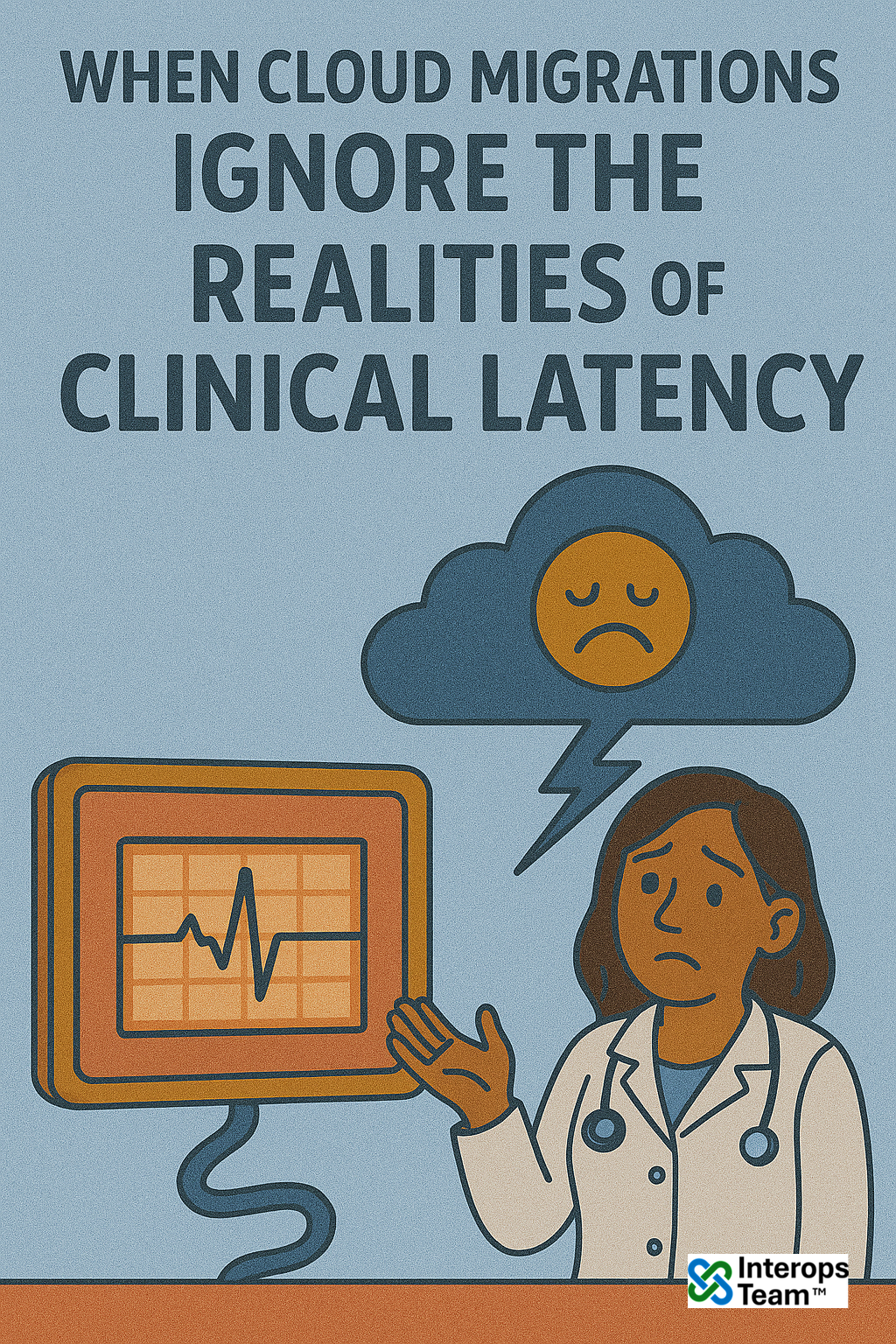
Cloud migrations promise scalability, modernization, and architectural freedom. Yet many healthcare organizations discover a harsh truth only after go-live: clinical workflows cannot tolerate latency the way business applications can. Tools that once responded instantly now pause at crucial steps, slowing documentation, introducing hesitations, and frustrating clinicians at the exact moments when speed matters most. EMR's are already slow, because they are built to deliver quality over efficiency, everything persisted is a set of complex transactions, which are journaled in real-time, everything is audited in real-time, adding any kind of latency will propagate and be reflected throughout clinical workflows.
Much of this pain stems from assuming that traditional client-server latency translate directly to cloud environments. In reality, network distance, TLS overhead, API routing, and distributed dependencies all introduce subtle delays. These may be measured in milliseconds individually, but collectively they create the sensation of a sluggish system.
Clinical workflows amplify this issue. Nurses documenting vitals, pharmacists verifying orders, and physicians navigating patient charts interact with systems in rapid succession. A 200-millisecond delay repeated across dozens of actions becomes minutes of lost productivity per provider per shift. Over time, these micro-delays erode satisfaction and drive calls for rollback.
Lift-and-shift migrations often fail because they do not address these workflow-specific constraints. Applications are moved to the cloud without redesigning caching strategies, optimizing data retrieval paths, or minimizing round-trips to external systems. The result is a cloud infrastructure that is technically modern but operationally inferior.
Successful cloud strategies treat latency as a first-class requirement. They invest in edge services, clinical-aware caching, local failover patterns, and architectural refactoring—not just VM relocation. When cloud modernization respects the clinical realities of speed and responsiveness, the benefits finally outweigh the tradeoffs.
Cloud moves that respect bedside latency
Interops Team™ helps you plug cloud aspirations into the realities of clinical latency, network behavior, and failover. We focus on making sure critical workflows stay fast and reliable as systems move.
- Model latency-sensitive workflows before migrating key components
- Design local caching and hybrid patterns for downtime and degradation
- Build observability that can distinguish network, app, and workflow issues