


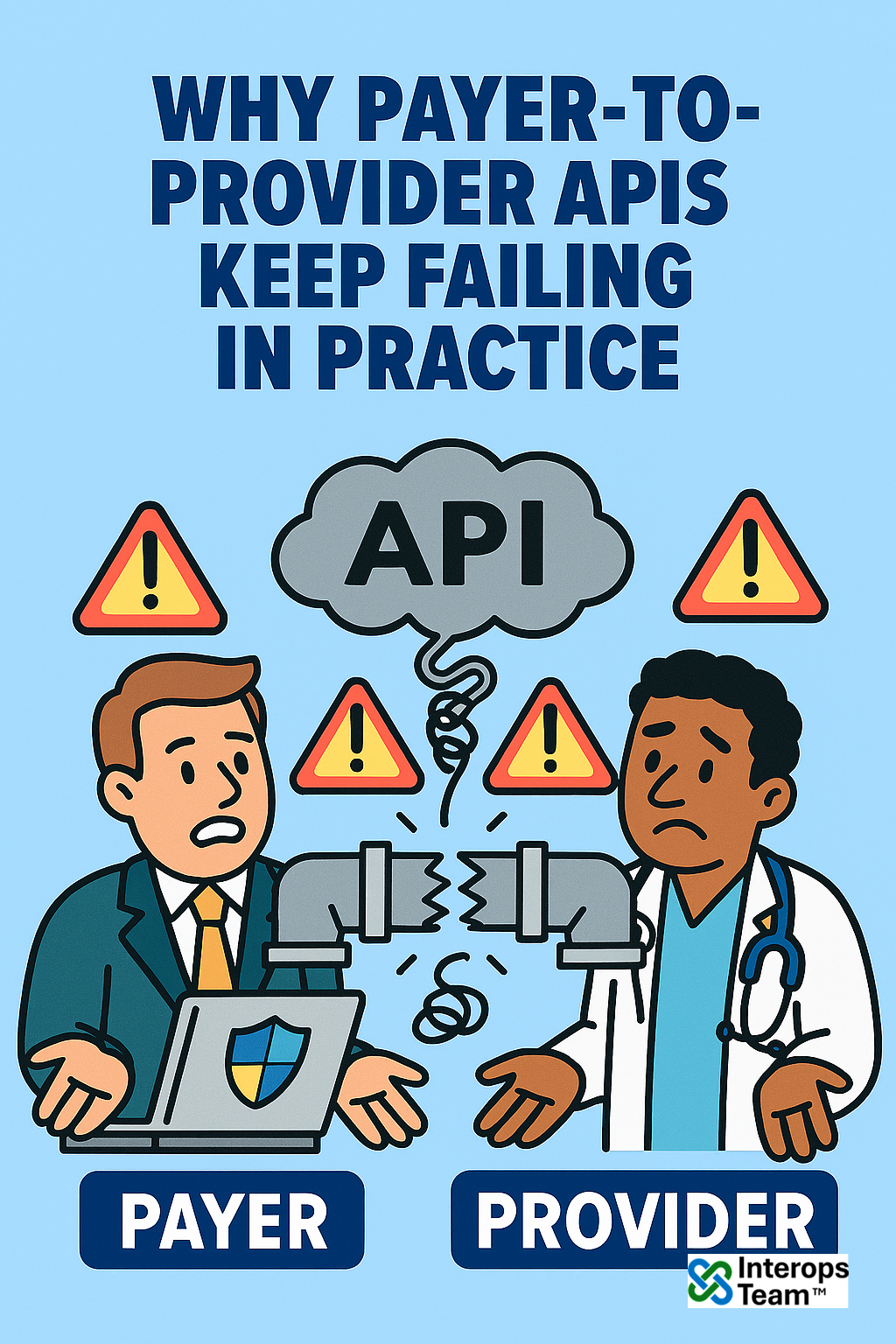
Payer-to-provider APIs are often presented as the missing link for value-based care, care coordination, and prior authorization reform. Standards and implementation guides describe how clinical and claims data should flow, and vendors showcase demonstrations where information appears instantly at the point of care. Yet in real implementations, these APIs frequently underperform. Providers struggle to integrate payer data into clinical workflows, and the promised improvements in efficiency and outcomes fail to materialize.
The core issue is not the absence of technical standards, but the misalignment between payer data models and clinical reality. Payer systems are optimized for eligibility, benefits, and claims, not for real-time, patient-centered decision-making. Data is often historical, incomplete, or derived from sources outside the provider's trusted ecosystem. When such data is surfaced directly in clinical workflows, it may conflict with EMR information or lack sufficient context for safe action. Providers are then asked to trust data that does not meet the same integrity threshold as their own systems.
Incentives further complicate adoption. Payers aim to reduce cost and manage risk, while providers prioritize patient outcomes and clinician efficiency. When APIs are designed primarily to serve payer objectives, workflows can feel imposed rather than collaborative. For example, prior authorization APIs that expose requirements without simplifying documentation or aligning with EMR ordering patterns simply shift administrative work from fax to screen. The technology changes, but the burden remains.
For payer-to-provider APIs to succeed, they must be grounded in shared trust, interoperable data models, and genuinely collaborative workflows. This means investing in data quality, aligning terminologies, and co-designing flows with providers so that information appears in the right place, at the right time, in the right format. It also requires acknowledging that not all payer data is suitable for direct clinical consumption; some of it belongs in operational workflows rather than bedside decisions. When these realities are addressed, APIs can move from checkbox compliance to meaningful impact.
Making payer-provider APIs actually usable
Interops Team™ helps translate payer APIs into workflows clinicians can trust. We bridge Da Vinci specs, payer implementations, and EMR realities so providers can plug into APIs without drowning in low-value data.
- Review payer API contracts and map them to real EMR workflows
- Normalize and curate data so recommendations align with local clinical standards
- Design governance around which payer signals become part of the trusted core